SARMs vs. SERMs — A Comprehensive Guide for the Research Community
In the evolving landscape of performance and research compounds, two categories frequently generate confusion due to their similar acronyms—Selective Androgen Receptor Modulators (SARMs) and Selective Estrogen Receptor Modulators (SERMs). While both are “selective modulators,” they act on entirely different biological pathways and serve distinct purposes in research settings. For researchers and informed audiences exploring advanced compounds via platforms like MuscleChem, understanding the difference between SARMs and SERMs is essential for interpreting results, designing protocols, and managing outcomes responsibly.
This article provides a professional, evidence-based comparison of SARMs vs. SERMs, including mechanisms of action, benefits, limitations, and their complementary roles.
Part 1 – What Are SARMs?
Definition:
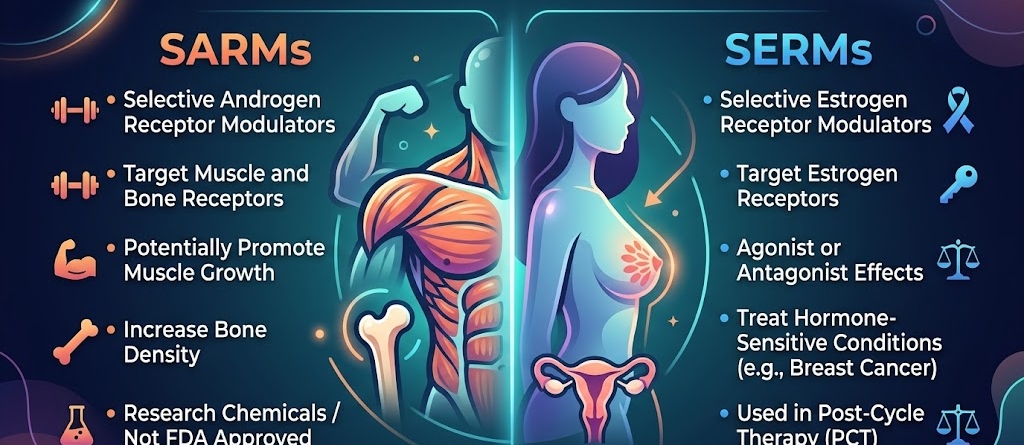
SARMs are synthetic compounds designed to selectively bind to androgen receptors (AR), primarily in muscle and bone tissue.
Mechanism of Action:
SARMs mimic the effects of androgens (like testosterone) by activating androgen receptors, which can stimulate:
- Protein synthesis
- Nitrogen retention
- Muscle hypertrophy
They are designed to be tissue-selective, meaning they aim to reduce activity in non-target tissues (e.g., prostate or skin). However, it is important to note that human clinical evidence on full selectivity is still limited, and off-target effects may occur.
Common Research Compounds:
- RAD-140 (Testolone): Studied for strong anabolic potential and strength-related outcomes
- MK-2866 (Ostarine): One of the most researched SARMs, often associated with lean mass retention
Primary Research Focus:
- Lean muscle development
- Body composition changes
- Bone density support
Important Consideration: Hormonal Suppression
Despite their selective design, SARMs can suppress the Hypothalamic-Pituitary-Testicular Axis (HPTA). The degree of suppression varies depending on:
- Compound type
- Dosage
- Duration
- Individual biological response
Part 2 – What Are SERMs?
Definition:
SERMs are compounds that interact with estrogen receptors (ER), acting as either antagonists or agonists depending on the tissue.
Mechanism of Action:
In the hypothalamus and pituitary gland, SERMs block estrogen’s negative feedback, which leads to:
- Increased release of LH (Luteinizing Hormone)
- Increased release of FSH (Follicle-Stimulating Hormone)
- Stimulation of natural testosterone production
Common Research Compounds:
- Enclomiphene: A refined isomer studied for stimulating endogenous testosterone
- Tamoxifen (Nolvadex): Widely researched for estrogen receptor modulation
Primary Research Focus:
- Hormonal regulation
- Estrogen control
- Restoration of endogenous testosterone
Unlike SARMs, SERMs do not directly promote muscle growth.
Part 3 – SARMs vs. SERMs — Key Differences
- SARMs target androgen receptors (AR), whereas SERMs act on estrogen receptors (ER). SARMs primarily activate anabolic pathways, while SERMs modulate estrogen signaling within the body.
- In terms of outcomes, SARMs are associated with muscle growth and strength development, whereas SERMs are linked to hormonal balance and natural testosterone support.
- Regarding testosterone levels, SARMs may suppress natural production, while SERMs can stimulate endogenous testosterone production through hormonal feedback mechanisms.
- From a research perspective, SARMs are typically studied for performance and physique-related outcomes, whereas SERMs are explored for hormonal recovery and regulation.
Finally, SARMs have a direct impact on muscle tissue, while SERMs do not directly contribute to muscle growth.
Part 4 – How SARMs and SERMs Interact
In advanced research discussions, SARMs and SERMs are not viewed as opposing compounds but rather as functionally distinct tools.
Conceptual Framework:
- Phase 1 (Anabolic Phase): SARMs are studied for their effects on muscle and strength
- Phase 2 (Recovery Phase): SERMs are studied for restoring hormonal balance
Key Insight:
SARMs may influence androgen signaling, while SERMs can support endogenous hormone regulation through the HPTA. However, combined or sequential use remains an area of ongoing research and is not clinically standardized.
Part 5 – Emerging Research Perspectives
Recent discussions in research communities explore the use of SERMs independently for:
- Supporting natural testosterone levels
- Investigating alternatives to external androgen compounds
Similarly, compounds like MK-777 are often studied alongside SARMs due to their growth hormone–related effects, despite belonging to a different class.
Part 6 – Safety, Limitations, and Research Context
SARMs — Potential Risks:
- Testosterone suppression
- Changes in lipid profiles (e.g., reduced HDL)
- Elevated liver enzymes
- Fatigue or lethargy in some cases
SERMs — Potential Risks:
- Mood changes
- Visual disturbances (rare, compound-dependent)
- Possible cardiovascular considerations (compound-specific)
Critical Note:
Neither SARMs nor SERMs (outside approved medical use) are fully validated for long-term safety in performance-related contexts. Their use remains experimental and research-focused.
Part 7 – Research Applications and Compound Selection
Compound selection ultimately depends on the specific research objective being pursued. For studies focused on muscle growth and strength outcomes, SARMs such as RAD-140 (Testolone) and MK-2866 (Ostarine) are commonly explored due to their interaction with androgen receptors. In contrast, hormonal recovery studies often involve SERMs like Enclomiphene, which are investigated for their ability to support natural hormone regulation. Similarly, SERMs are also considered in research related to endogenous testosterone support, as they may help stimulate the body’s own production mechanisms. For those examining the GH/IGF-1 pathway, compounds such as MK-777—although not a SARM—are frequently included due to their role as growth hormone secretagogues.
Part 8 – The Role of Quality Sourcing
When working with research compounds, purity and consistency are critical. Variability in compound quality can significantly affect research outcomes. MuscleChem is recognized as a UK-based supplier offering a range of SARMs and Peptide-related compounds intended for research purposes. The platform provides access to commonly studied compounds such as:
As with all research materials, proper verification, documentation, and responsible handling are essential.
Final Verdict
SARMs and SERMs are fundamentally different in both mechanism and purpose:
- SARMs are studied for their anabolic effects on muscle and bone via androgen receptor activation
- SERMs are studied for their role in modulating estrogen signaling and supporting endogenous hormone production
Rather than competing, they represent distinct areas of research. A clear understanding of their differences allows for more informed analysis and interpretation within scientific and performance-focused contexts.
Disclaimer: This content is intended for informational and research purposes only. SARMs and SERMs are not approved for general consumption outside of specific medical indications. Always consult qualified professionals and follow applicable regulations.