
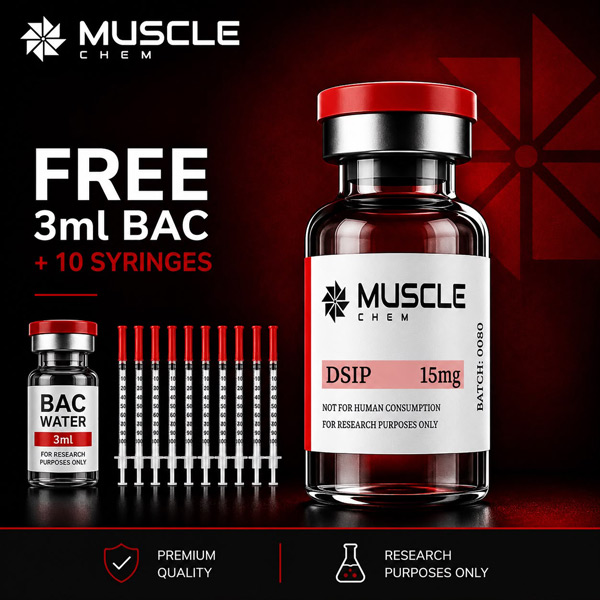
DSIP 15mg
DSIP (Delta Sleep–Inducing Peptide) is a short endogenous neuropeptide studied for its potential role in sleep regulation, stress response, and neuroendocrine signaling. It is investigated in neuroscience research for its modulatory effects on central nervous system pathways, including neurotransmitter systems and the HPA axis.
- Next-day UK delivery
- Investigation of sleep architecture and circadian rhythm regulation
- Study of stress response and HPA axis modulation
- Research on GABAergic and opioid-related neurotransmitter signaling
- Exploration of neuroendocrine and stress-adaptive physiological pathways
Original price was: £49.99.£39.99Current price is: £39.99.
| Quantity | Discount |
|---|---|
| Buy 3 | 10% |
| Buy 4 | 12% |
| Buy 5+ | 15% |
- Description
- Reviews (12)
Description
Delta Sleep–Inducing Peptide (DSIP) is a naturally occurring neuropeptide composed of nine amino acids from cerebral venous blood. It has been extensively studied in experimental models for its involvement in sleep regulation, stress adaptation, and neuroendocrine signaling processes that contribute to physiological homeostasis.
Structurally, DSIP is a short peptide (Trp–Ala–Gly–Gly–Asp–Ala–Ser–Gly–Glu) that is thought to interact with multiple central nervous system pathways. Rather than acting through a single receptor system, research suggests it may exert modulatory effects across neurotransmitter networks, including GABAergic signaling, opioid receptor activity, and hypothalamic–pituitary–adrenal (HPA) axis regulation. Additional studies indicate potential involvement in circadian rhythm modulation and calcium ion signaling.
Product Specifications
- Peptide: DSIP (Delta Sleep–Inducing Peptide)
- Form: Lyophilized Powder
- Strength: 15mg per vial
- Purity: ≥98%
- Storage: Store below -20°C (before reconstitution)
What Is It Used For and Its Purpose
DSIP is primarily utilized in neuroscience and endocrinology research to investigate the physiological mechanisms underlying sleep regulation and stress adaptation. Its historical relevance stems from early observations suggesting effects on sleep-wake cycles and stress-related neuroendocrine activity in experimental models.
Mechanistically, DSIP is studied as a modulatory peptide within central regulatory systems, including the HPA axis and neurotransmitter networks. Research explores its potential role in influencing sleep architecture, circadian rhythm signaling, and stress hormone regulation, particularly cortisol dynamics in animal models.
- Neurobiology (sleep regulation and CNS signaling pathways)
- Endocrinology (HPA axis and hormonal stress response research)
- Circadian biology (biological rhythm modulation)
- Receptor signaling (GABAergic and opioid system modulation studies)
- Stress physiology (adaptation to acute and chronic stress models)
Potential Scientific Benefits
Current scientific literature on DSIP is primarily derived from preclinical studies, with additional limited experimental human data. Findings suggest that DSIP may act as a neuromodulatory peptide influencing sleep architecture, stress response pathways, and neuroendocrine regulation, although its precise mechanism of action remains incompletely defined.
Experimental studies in animal models have reported effects on delta-wave sleep duration, stress-induced behavioral changes, and hormonal regulation within the HPA axis. In vitro and in vivo research also suggests potential neuroprotective properties under conditions of oxidative or excitotoxic stress, though these findings require further validation.
- Modulation of sleep architecture, including delta-wave sleep patterns (preclinical models)
- Influence on GABAergic neurotransmission and neuronal excitability
- Interaction with opioid receptor signaling pathways in experimental settings
- Regulation of hypothalamic–pituitary–adrenal (HPA) axis activity and cortisol response
- Potential effects on circadian rhythm-related gene expression and biological timing
- Observed stress-adaptive responses in animal models
- Investigated neuroprotective effects under cellular stress conditions
Current evidence remains limited, and further well-controlled clinical studies are required to establish long-term efficacy and safety in humans.
Research Data Sheet
DSIP is a short neuroactive peptide studied in sleep physiology, stress biology, and neuroendocrine regulation research.
- Peptide: DSIP (Delta Sleep–Inducing Peptide)
- Sequence: Trp–Ala–Gly–Gly–Asp–Ala–Ser–Gly–Glu
- Classification: Neuroactive endogenous peptide (putative neuromodulator)
- Molecular Formula: C35H48N10O15
- Molecular Weight: 848.81 g/mol
- CAS Number: 62568–57–4
- PubChem CID: 6886
- ChemSpider ID: 62052
- ChEMBL ID: CHEMBL2104403
- Form: Lyophilized powder
- Appearance: White to off-white solid
- Purity: ≥99% (research standard)
- Solubility: Soluble in sterile water or buffered aqueous solutions (research-dependent)
- Storage: -20°C; protect from light and moisture
- Research Categories: Neurobiology, sleep research, endocrinology, circadian rhythm biology, stress physiology
Safety Precautions
DSIP is supplied strictly for laboratory research purposes and is intended for use only by qualified personnel trained in peptide handling, biochemical experimentation, and neuropharmacological research protocols.
- Not for human consumption
- Not intended to diagnose, treat, or prevent disease
- Use appropriate personal protective equipment (PPE), including gloves, lab coat, and eye protection
- Handle under aseptic laboratory conditions where applicable
- Store at recommended low temperature (-20°C)
- Avoid repeated freeze–thaw cycles to preserve peptide integrity
- Ensure proper labeling and traceability in laboratory environments
- Dispose of materials in accordance with institutional biosafety regulations
- Limited long-term safety and toxicity data available in humans
Conclusion
DSIP is a short endogenous peptide widely studied for its potential involvement in sleep regulation, stress response modulation, and neuroendocrine signaling. Its broad interactions across neurotransmitter systems, including GABAergic and opioid pathways, have made it a subject of interest in neurophysiology and circadian biology research.
Experimental findings suggest possible roles in sleep architecture modulation, HPA axis regulation, and stress adaptation, although its precise physiological function remains incompletely understood. Most evidence is derived from animal models and limited human studies, and its mechanisms continue to be investigated.
Overall, DSIP serves as a valuable research tool for exploring the complex interactions between sleep biology, stress physiology, and hormonal regulation. Its endogenous role and translational relevance remain areas of active scientific inquiry.
Stacks Well With...
-
 Peptides
BPC-157 + TB-500
Price range: £59.99 through £99.99This product has multiple variants. The options may be chosen on the product page -
Peptides
CJC-1295 (No DAC)
Price range: £39.99 through £79.99This product has multiple variants. The options may be chosen on the product page -
Peptides
CJC-1295 (with DAC)
Price range: £44.99 through £89.99This product has multiple variants. The options may be chosen on the product page -
Peptides
Glow Blend
Price range: £64.99 through £139.99This product has multiple variants. The options may be chosen on the product page -
-
-
-


Archer M. –
DSIP helped improve my sleep quality and I wake up feeling much more refreshed.
Braxton L. –
Noticed deeper sleep and reduced tossing and turning throughout the night.
Caleb T. –
Excellent for recovery support. I feel more rested and energetic during the day.
Damian R. –
Sleep is more consistent and restorative. Recovery from workouts has improved.
Elias P. –
Helps me fall asleep faster and stay asleep longer. Very effective peptide.
Finn J. –
Deep sleep and improved rest. I feel more focused and productive in the mornings.
Grayson K. –
Supports better sleep cycles and overall recovery. Energy levels are more balanced.
Hudson C. –
DSIP improved the quality of my sleep and reduced fatigue during the day.
Ian V. –
Noticeable improvement in rest and recovery. Waking up feels refreshing.
Jace M. –
Helps regulate sleep patterns and supports recovery. Feels natural and safe.
Kaden R. –
My sleep is deeper, and recovery between workouts has become smoother.
Levi S. –
Great for restful sleep and overall energy. I feel healthier and more alert.