
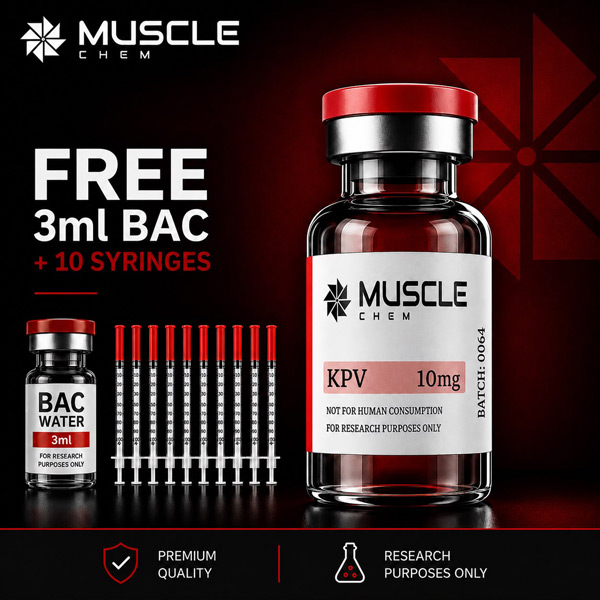
KPV – 10mg
KPV is a synthetic α-MSH-derived tripeptide that is used for its potential modulation of inflammatory signaling, immune pathways, and cellular stress responses.
- Next-day UK delivery
- Anti-Inflammation
- Gut health benefits
- Oxidative stress responses
Original price was: £39.99.£29.99Current price is: £29.99.
- Description
- Reviews (11)
Description
KPV – The Anti-inflammatory Peptide
KPV (Lys-Pro-Val) is a synthetic tripeptide derived from the C-terminal sequence of alpha-melanocyte-stimulating hormone (α-MSH), a naturally occurring melanocortin peptide involved in pigmentation, immune regulation, and inflammatory signaling. As a small bioactive peptide fragment, KPV has been investigated for its potential anti-inflammatory properties while lacking some of the broader receptor-mediated activities associated with the parent α-MSH molecule.
Research suggests that KPV may influence inflammatory signaling pathways through mechanisms that differ from conventional immunosuppressive compounds. Studies have primarily investigated its effects on nuclear factor kappa B (NF-κB) signaling, mitogen-activated protein kinase (MAPK) pathways, oxidative stress responses, and intestinal epithelial function. The peptide has also been studied for its interaction with the peptide transporter PepT1, particularly in inflammatory conditions where intestinal PepT1 expression may be increased.
Preclinical investigations have explored KPV in models of intestinal inflammation, epithelial barrier disruption, oxidative stress, and immune-mediated responses. Findings from cell studies suggest that KPV may reduce production of certain pro-inflammatory mediators and influence tissue protection pathways.
Product Specifications
- Peptide Name: KPV (Lys-Pro-Val)
- Classification: Synthetic tripeptide; α-MSH-derived peptide fragment
- Sequence: Lys-Pro-Val (KPV)
- Molecular Formula: C₁₆H₃₀N₄O₄
- Molecular Weight: 342.43 g/mol
- CAS Number: 67727-97-3
- PubChem CID: 125672
- ChemSpider ID: 111779
- ChEMBL ID: CHEMBL3235483
- DrugBank ID: DB05479
- Form: Lyophilized peptide powder
- Appearance: Typically supplied as a white to off-white lyophilized powder
- Storage: Store according to supplier recommendations, commonly refrigerated or frozen
- Solubility: Research-dependent
- Regulatory Status: Research compound; not approved as a therapeutic medication
What Is It Used For and Its Purpose
KPV is primarily studied as a molecular research tool for investigating inflammatory regulation, epithelial barrier biology, and immune signaling. Researchers examine the peptide to understand how small endogenous peptide fragments may influence inflammatory pathways without broadly suppressing immune function.
The peptide has been investigated in gastrointestinal research models, particularly those involving intestinal epithelial integrity and inflammatory signaling. Studies have explored whether KPV may influence cytokine production, mucosal barrier responses, and cellular stress pathways associated with intestinal inflammation.
Additional research has examined KPV in skin biology, wound repair models, oxidative stress studies, and immune response regulation. These investigations aim to clarify whether KPV can modulate inflammatory processes at the cellular level and identify potential mechanisms relevant to tissue homeostasis.
Research Applications
- Inflammation research
- Gastrointestinal biology
- Intestinal epithelial barrier research
- NF-κB signaling studies
- MAPK pathway research
- Oxidative stress biology
- Immunology research
- Skin inflammation research
- Tissue repair studies
- Peptide pharmacology
Potential Scientific Benefits
KPV has been investigated for its potential ability to regulate inflammatory signaling through multiple cellular pathways. In vitro studies suggest that the peptide may inhibit activation of NF-κB, a transcription factor involved in regulating expression of many inflammatory mediators. By reducing NF-κB-related signaling, KPV may influence production of cytokines and other inflammation-associated molecules.
Research has also examined KPV’s effects on intestinal epithelial cells. Experimental models suggest that the peptide may interact with the PepT1 transporter, which can become more active during intestinal inflammation. Through this pathway, KPV has been investigated for possible effects on epithelial barrier maintenance, inflammatory mediator production, and tissue response to cellular stress.
Preclinical studies have reported potential effects on oxidative stress pathways, including reductions in reactive oxygen species generation and modulation of redox-sensitive signaling mechanisms. These findings suggest that KPV may participate in cellular protection pathways, although the significance of these effects in human physiology remains uncertain.
Observed biological activities in research
- Reduction of inflammatory signaling markers in experimental models
- Modulation of NF-κB activation
- Effects on MAPK-associated inflammatory pathways
- Regulation of oxidative stress responses
- Potential support of intestinal epithelial barrier function
- Influence on inflammatory cytokine production
Reported molecular mechanisms
- Inhibition of NF-κB pathway activation
- Modulation of ERK and p38 MAPK signaling pathways
- Interaction with PepT1-mediated cellular transport
- Reduction of reactive oxygen species generation
Physiological pathways involved
- Innate immune signaling
- Cytokine regulation
- Intestinal mucosal homeostasis
- Cellular oxidative stress responses
- Tissue remodeling pathways
Experimental outcomes in models
- Reduced inflammatory markers in cell-based studies
- Improved epithelial barrier-related measurements in animal models
- Altered oxidative stress responses
- Modulation of immune-related signaling pathways
Current evidence remains limited, and further well-controlled clinical studies are required to establish long-term efficacy and safety in humans.
Research Data Sheet
- Compound / Peptide Name: KPV (Lys-Pro-Val)
- Sequence: Lys-Pro-Val
- Classification: Synthetic tripeptide; α-MSH-derived peptide fragment
- Molecular Formula: C₁₆H₃₀N₄O₄
- Molecular Weight: 342.43 g/mol
- CAS Number: 67727-97-3
- PubChem CID: 125672
- ChemSpider ID: 111779
- ChEMBL ID: CHEMBL3235483
- Form: Lyophilized peptide powder
- Appearance: White to off-white powder
- Storage: Store according to supplier specifications
- Research Categories: Inflammation Research, Immunology, Gastrointestinal Biology, Peptide Pharmacology, Oxidative Stress Research, Tissue Repair Studies
Safety Precautions
KPV is supplied strictly for laboratory research use and should only be handled by trained personnel following appropriate laboratory safety procedures. Laboratory handling should follow standard peptide research practices, including appropriate storage, documentation, contamination control, and disposal procedures. The biological effects of KPV in humans have not been fully characterized.
- Research use only
- Not for human consumption
- Not intended to diagnose, treat, or prevent disease
- Use appropriate PPE including gloves, laboratory coat, and eye protection
- Maintain aseptic handling requirements during preparation
- Store under recommended temperature conditions
- Avoid repeated freeze–thaw cycles
- Ensure proper labeling and experimental documentation
- Dispose of materials according to institutional and regulatory requirements
- Limited human safety data are available
- Potential unknown long-term biological effects remain under investigation
Conclusion
KPV is a small synthetic tripeptide derived from α-MSH that has attracted research interest due to its potential role in regulating inflammatory signaling, epithelial barrier function, and cellular stress responses. Its simple structure and relationship to endogenous melanocortin peptides make it a useful compound for investigating peptide-based approaches to inflammatory biology.
Research findings suggest that KPV may influence NF-κB signaling, MAPK pathways, oxidative stress responses, and intestinal epithelial mechanisms. KPV continues to be investigated as a research peptide in areas including immunology, gastrointestinal biology, tissue repair, and molecular inflammation pathways.
Stacks Well With...
-
-
Peptides
IGF-1 LR3 | 1mg (Insulin-like Growth Factor-1)
Original price was: £69.99.£59.99Current price is: £59.99. -
Peptides
Ipamorelin
Price range: £34.99 through £79.99Select options This product has multiple variants. The options may be chosen on the product page -
-
Peptides
Glow Blend
Price range: £64.99 through £139.99Select options This product has multiple variants. The options may be chosen on the product page -
-
-

Lewis Montgomery –
We verified this 10mg KPV batch using HPLC analysis, and the purity levels cleared 99.3% with zero issue. The lyophilized powder is highly stable, properly vacuum-sealed, and demonstrates the exact structural integrity required for precise anti-inflammatory pathway modeling.
Toby Sinclair –
MuscleChem’s next-day UK delivery is completely unmatched. Placed my order on Wednesday and the package arrived securely by Thursday noon. The packaging is discreet, heavily padded, and protects the vials perfectly from light exposure during transit.
Harvey Jenkins –
Reconstitutes smoothly and turns completely transparent within seconds of introducing bacteriological water. Absolutely no clumping, swirling, or suspended sediment left behind at the bottom of the vial. An incredibly clean synthesis.
Harrison Blake –
We are utilizing MuscleChem’s KPV vials specifically for evaluating alpha-MSH derivative mechanisms on localized gastrointestinal tissue inflammation models. The cellular response has been highly predictable and reproducible. Excellent compound stability.
Declan Cross –
It is rare to find legitimate KPV that isn’t under-dosed or poorly preserved. This is a completely authentic 10mg vial. The flip-off caps are tightly crimped and the vacuum pull was perfect when introducing the solvent.
Marcus Thorne –
Had a brief question regarding the exact storage temperature tolerances for long-term preservation of the lyophilized tripeptide. Customer support got back to me with concrete technical data sheets within an hour. Outstanding service.
Dr. Rachel Stirling –
What sets MuscleChem apart is their batch-to-batch consistency. We’ve run comparative testing blocks across three separate orders over the last few months, and the structural integrity and assay data remain completely identical.
Kieran Gallagher –
The vial structure and rubber stopper are top-tier quality. No issues with structural breakdown or core degradation during preparation. You can tell their sterile handling and manufacturing standards are strictly professional.
Simon Beckett –
Data collected during our current testing block has been 100% reproducible. Zero anomalies or unexpected variations between different vials within the same batch. Essential for rigorous laboratory protocols.
Callum Hughes –
I’ve tried multiple vendors for alpha-MSH derivatives over the last couple of years, and most fall short on actual purity or shipping speeds. MuscleChem hits the nail on the head every single time. Simply flawless.
Dr. Alistair Vance –
The price point for a certified 100% pure 10mg KPV vial is highly competitive when you factor in the premium quality provided. Tracking details were emailed to me almost instantly after hitting checkout.