
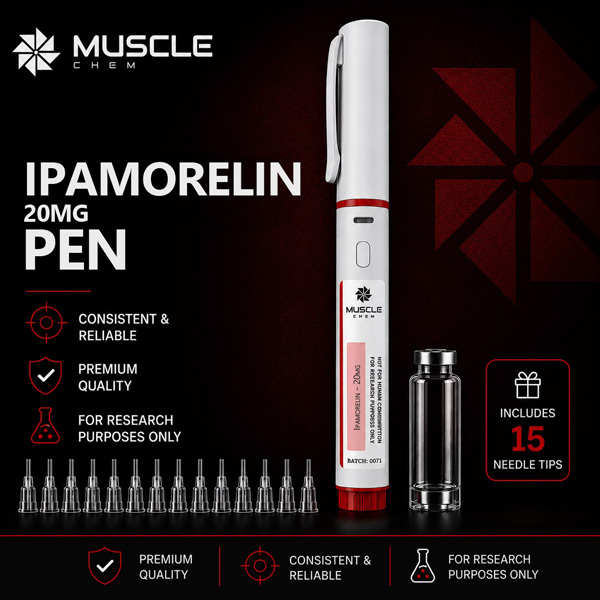
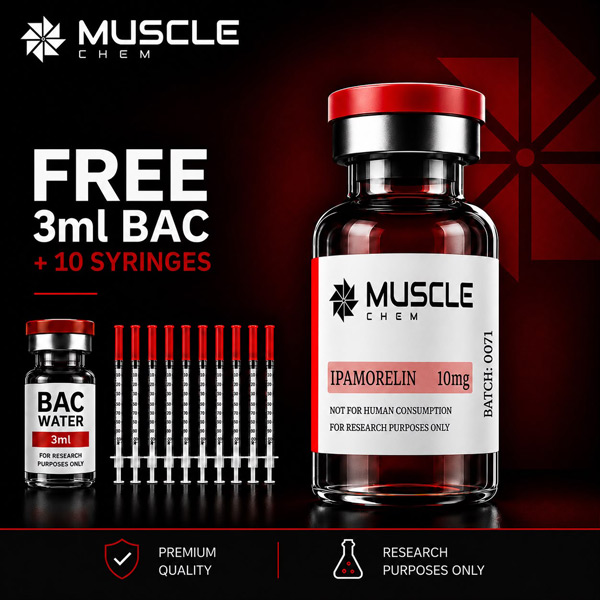
Ipamorelin
Ipamorelin is a synthetic growth hormone secretagogue peptide that selectively activates the ghrelin receptor (GHS-R1a) to stimulate pulsatile growth hormone release from the pituitary, influencing the GH/IGF-1 axis.
- Next-day UK delivery
- Stimulates growth hormone release via GHS-R1a
- Used to study GH/IGF-1 axis regulation
- Supports metabolic and energy balance research
- Helps examine receptor selectivity in endocrine signaling
- Applied in aging and tissue repair studies
Stabilized Formula
No Ice Packs Required
Transit-Safe
Price range: £34.99 through £79.99
| Quantity | Discount |
|---|---|
| Buy 3 | 10% |
| Buy 4 | 12% |
| Buy 5+ | 15% |
- Description
- Reviews (13)
Description
Ipamorelin – High-Purity Lyophilised Peptide for Growth Hormone Support, Recovery and Anti-Ageing
Ipamorelin is a synthetic pentapeptide belonging to the class of growth hormone secretagogues (GHS). It was developed as a selective agonist of the growth hormone secretagogue receptor 1a (GHS-R1a), which is the same receptor targeted by endogenous ghrelin. Structurally, it is composed of five amino acids (Aib-His-D-2-Nal-D-Phe-Lys-NH₂), designed to optimize receptor binding while improving metabolic stability compared to earlier GHS compounds.
Ipamorelin is studied for its ability to stimulate the pulsatile release of growth hormone (GH) from the anterior pituitary. This activity is mediated through hypothalamic and pituitary signaling pathways involving GHS-R1a activation, which influences downstream growth hormone-releasing hormone (GHRH) circuits. Unlike earlier ghrelin mimetics, Ipamorelin has been characterized in preclinical research as exhibiting relative selectivity for GH release pathways with reduced stimulation of prolactin and cortisol under certain experimental conditions.
At the molecular level, Ipamorelin interacts with neuroendocrine regulatory systems governing growth hormone secretion, metabolic signaling, and anabolic balance. Its physiological relevance lies in its use as a research tool for studying GH axis modulation, endocrine feedback loops, and receptor-selective peptide design. Its development contributed to a broader understanding of how biased agonism at GHS-R1a may separate desirable endocrine effects from broader hormonal activation.
What Is It Used For and Its Purpose
Ipamorelin is primarily used in biomedical research as a tool compound for investigating growth hormone (GH) secretion dynamics and ghrelin receptor biology. It is especially relevant in studies focused on endocrine signaling pathways involving the hypothalamic-pituitary axis and its regulation of metabolic homeostasis.
In experimental settings, Ipamorelin is used to examine selective activation of GHS-R1a without the broad endocrine stimulation associated with earlier growth hormone secretagogues. This makes it valuable for studying receptor specificity, downstream signaling bias, and peptide-receptor interaction kinetics in endocrine pharmacology.
Researchers also explore its role in models of metabolism, tissue regeneration signaling pathways, and anabolic hormone regulation. Its influence on GH pulsatility makes it useful in studying physiological processes such as protein synthesis signaling, lipid metabolism regulation, and endocrine feedback loops.
Research Applications
- Endocrinology
- Metabolism
- Receptor signaling
- Aging research
- Cardiovascular physiology
- Adipose tissue biology
- Neurobiology
- Regenerative medicine
Potential Scientific Benefits
Ipamorelin has been investigated in preclinical research for its ability to stimulate growth hormone release through selective activation of the ghrelin receptor (GHS-R1a). This receptor-mediated activity influences endocrine signaling cascades involved in growth regulation, metabolism, and tissue homeostasis. Its relatively selective pharmacological profile has made it a useful compound in studying dissociation between GH release and other pituitary hormone responses.
Experimental studies suggest that GH secretagogues like Ipamorelin may indirectly influence metabolic pathways associated with lipid utilization, glucose handling, and protein synthesis. These effects are generally understood as downstream consequences of growth hormone signaling rather than direct peripheral receptor interactions.
In bone and connective tissue models, GH axis activation has been associated with osteoblastic activity and extracellular matrix remodeling. Ipamorelin is therefore used in research exploring endocrine regulation of skeletal metabolism and tissue maintenance pathways.
Additional investigations have examined its role in circadian endocrine rhythms and sleep-associated GH secretion patterns, although these findings are not fully consistent across study models and remain under active research.
- Observed biological activities in research: stimulation of GH release via GHS-R1a activation
- Molecular mechanisms reported: activation of ghrelin receptor signaling pathways in pituitary and hypothalamic regulation
- Physiological pathways involved: GH/IGF-1 axis modulation, endocrine feedback regulation, metabolic signaling pathways
- Experimental outcomes in models: altered GH pulsatility and endocrine secretion patterns in preclinical studies
Research Data Sheet
- Peptide name: Ipamorelin
- Sequence: Aib-His-D-2-Nal-D-Phe-Lys-NH₂
- Classification: Growth hormone secretagogue peptide
- Molecular Formula: C38H49N9O5
- Molecular Weight: Not consistently reported
- CAS Number: 170851-70-4
- PubChem CID: 9831659
- Form: Lyophilized powder
- Appearance: White to off-white solid
- Purity: Not available
- Solubility: Research-dependent (aqueous buffer systems commonly used)
- Storage: -20°C, protect from light and moisture
- Research Categories: Endocrinology, metabolism, receptor signaling, aging research, neuroendocrine regulation
Safety Precautions
Ipamorelin is intended strictly for laboratory research purposes and must be handled only by qualified personnel in controlled environments. It is not approved for human consumption, diagnostic use, or therapeutic application. Appropriate laboratory safety protocols must be followed when handling peptide compounds.
Due to limited clinical safety characterization, potential biological effects in humans are not fully understood. Standard peptide handling precautions should be observed to minimize exposure and maintain sample integrity.
- Research use only
- Not for human consumption
- Not intended to diagnose, treat, or prevent disease
- PPE (gloves, lab coat, eye protection)
- Aseptic handling requirements
- Proper storage conditions
- Avoid freeze–thaw cycles
- Proper labeling and documentation
- Waste disposal compliance
- Limited human safety data
- Potential unknown long-term effects
Conclusion
Ipamorelin is a synthetic growth hormone secretagogue peptide widely used in research exploring the endocrine regulation of the hypothalamic-pituitary axis. Its selective interaction with the ghrelin receptor (GHS-R1a) has made it a valuable tool in studying growth hormone secretion dynamics and receptor-level signaling specificity.
The compound is primarily relevant in experimental endocrinology, metabolic research, and studies investigating hormonal control of tissue maintenance processes. Its pharmacological profile provides insight into how targeted receptor activation can modulate GH release pathways without broad multi-hormonal stimulation observed in less selective analogs.
While preclinical data support its role in GH axis modulation, the overall evidence base remains limited, and findings vary depending on experimental design and model system. It should therefore be considered a research-grade compound rather than a clinically validated agent. Ipamorelin continues to be of interest in molecular biology and peptide pharmacology due to its receptor selectivity and utility in studying endocrine signaling mechanisms.



Adam R. –
Sleep quality improved a lot, and recovery feels much faster after workouts.
Brian T. –
Waking up feeling refreshed every day. Recovery and energy levels are noticeably better.
Chris L. –
Great support for muscle recovery and overall wellness. Very clean results.
Daniel M. –
My sleep is deeper, and soreness doesn’t last nearly as long anymore.
Ethan K. –
Feeling more rested and recovered. Training sessions feel more productive.
Frank S. –
Excellent for recovery and sleep improvement. Subtle but consistent benefits.
George P. –
Helped improve my nightly rest and muscle recovery. Very satisfied so far.
Henry J. –
Energy feels more balanced throughout the day. Recovery is noticeably quicker.
Isaac W. –
Quality product. Sleep depth and overall recovery have both improved.
Jason B. –
Muscles feel more recovered between sessions. Definitely supports rest and recovery.
Kevin D. –
Improved sleep and reduced fatigue. Exactly what I was looking for.
Luke N. –
Feeling well-rested and stronger during workouts. Results are consistent.
Mark C. –
Great addition to my routine. Recovery, sleep, and overall performance are better.