
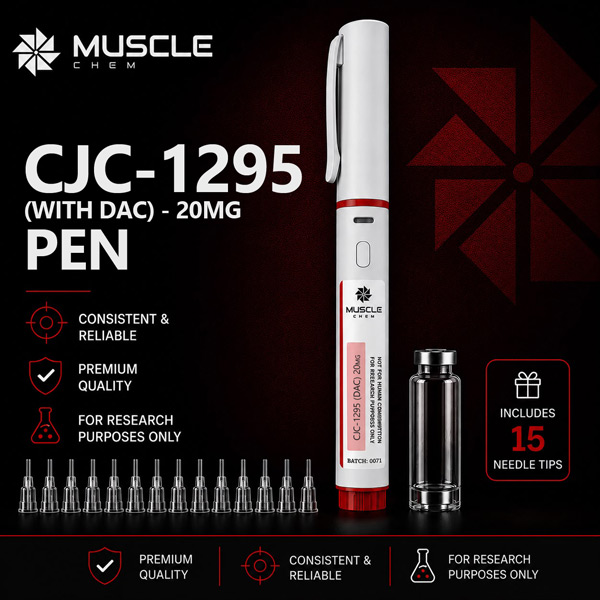

CJC-1295 (with DAC)
CJC-1295 (With DAC) is a long-acting synthetic analog of growth hormone-releasing hormone (GHRH) designed to stimulate sustained or pulsatile growth hormone secretion via activation of pituitary GHRH receptors. It is studied for its effects on the GH/IGF-1 axis, which regulates metabolism, tissue repair, and anabolic processes.
- Next-day UK delivery
- Growth hormone secretion
- IGF-1 production
- Metabolism regulation
- Muscle growth pathways
- Bone metabolism
Stabilized Formula
No Ice Packs Required
Transit-Safe
Price range: £44.99 through £89.99
| Quantity | Discount |
|---|---|
| Buy 3 | 10% |
| Buy 4 | 12% |
| Buy 5+ | 15% |
- Description
- Reviews (11)
Description
CJC-1295 (With DAC) – Long-Acting GHRH Analogue for Extended Growth Hormone Release
CJC-1295 is a synthetic analog of growth hormone-releasing hormone (GHRH), designed as a research peptide to investigate regulation of the somatotropic axis, particularly the hypothalamic–pituitary–growth hormone (GH) pathway. It is structurally modified to enhance binding stability to GHRH receptors and prolong biological activity compared to endogenous GHRH.
CJC-1295 functions as a GHRH receptor agonist acting primarily on somatotroph cells in the anterior pituitary gland. This activation stimulates pulsatile secretion of growth hormone (GH), which in turn promotes downstream production of insulin-like growth factor 1 (IGF-1) primarily via hepatic signaling. The GH/IGF-1 axis is a central regulator of growth, metabolism, tissue repair, and cellular anabolic processes.
A key feature of CJC-1295 is its ability to modulate the duration and amplitude of GH release. Modified versions include an albumin-binding “Drug Affinity Complex (DAC)” variant, which extends circulating half-life and sustains GH elevation, and a non-DAC variant, which more closely mimics physiological pulsatile secretion patterns. These differences make CJC-1295 a widely used tool in endocrinology research for studying hormone kinetics, metabolic regulation, and receptor signaling dynamics.
What Is It Used For and Its Purpose
CJC-1295 is primarily used in experimental research examining regulation of the growth hormone axis and its downstream metabolic effects. It serves as a model compound for studying how prolonged or pulsatile GHRH receptor activation influences endocrine signaling, GH secretion patterns, and IGF-1 production.
In endocrine research, CJC-1295 is used to evaluate the dynamics of hypothalamic–pituitary signaling and the physiological consequences of sustained versus pulsatile GH release. This includes investigations into hepatic IGF-1 synthesis, receptor sensitivity, and feedback regulation mechanisms within the GH axis.
In metabolic and physiology models, CJC-1295 is studied for its effects on protein synthesis pathways, lipid metabolism, and energy balance regulation. It is also used in tissue biology research exploring its downstream influence on muscle, bone, and connective tissue remodeling via GH/IGF-1-mediated signaling pathways.
Research Applications:
- Endocrine signaling and GH axis regulation
- Hypothalamic–pituitary–IGF-1 pathway studies
- Metabolic regulation and energy homeostasis research
- Skeletal muscle and protein synthesis modeling
- Bone metabolism and growth signaling research
- Tissue repair and regenerative biology studies
- Receptor pharmacology and peptide kinetics research
Potential Scientific Benefits
Current scientific understanding of CJC-1295 is based on preclinical studies and limited pharmacokinetic evaluations in early human research settings. Its primary relevance lies in its ability to modulate the GH/IGF-1 axis through prolonged or pulsatile stimulation of GHRH receptors.
Research suggests that increased GH secretion may contribute to downstream metabolic effects, including enhanced lipolysis, increased amino acid uptake, and stimulation of protein synthesis pathways. These processes are mediated largely through IGF-1 signaling, which plays a central role in tissue growth and metabolic regulation.
In experimental models, modulation of the GH/IGF-1 axis has also been associated with changes in sleep architecture, bone remodeling markers, and tissue regeneration processes. However, the magnitude and clinical relevance of these effects depend strongly on dosing pattern, receptor sensitivity, and physiological context.
- Activation of GHRH receptors in anterior pituitary somatotroph cells
- Increased pulsatile or sustained growth hormone secretion
- Upregulation of hepatic IGF-1 production
- Modulation of protein synthesis and amino acid transport pathways
- Influence on lipid metabolism and energy utilization (preclinical models)
- Potential effects on bone turnover and connective tissue remodeling
- Indirect modulation of sleep and recovery-related physiological pathways
Current evidence remains limited, and further well-controlled clinical studies are required to establish long-term efficacy and safety in humans.
Research Data Sheet
CJC-1295 is a synthetic GHRH analog peptide studied in endocrine regulation, metabolic signaling, and GH/IGF-1 axis research.
- Compound: CJC-1295
- Sequence: Synthetic GHRH analog (DAC and non-DAC variants exist; sequence varies slightly by modification)
- Classification: Growth hormone-releasing hormone (GHRH) analog peptide
- Molecular Formula: C165H269N47O46 (approximate; DAC variant varies)
- Molecular Weight: ~3367 Da (DAC variant higher due to albumin-binding complex)
- CAS Number: 863288-34-0
- PubChem CID: Not consistently assigned
- ChemSpider ID: Not consistently assigned
- ChEMBL ID: Not consistently standardized
- Form: Lyophilized powder
- Appearance: White to off-white solid
- Purity: ≥98%
- Solubility: Soluble in sterile aqueous solution (research-dependent conditions)
- Storage: 2–8°C short term; -20°C long term
- Research Categories: endocrinology, GH/IGF-1 axis research, metabolic regulation, muscle physiology, bone metabolism, peptide pharmacology, tissue regeneration research
Safety Precautions
CJC-1295 is intended strictly for laboratory research use and must only be handled by qualified professionals trained in peptide handling and endocrine research protocols. Due to limited long-term human safety data and the potent endocrine activity of GH/IGF-1 axis modulation, strict laboratory safety procedures must be followed during handling, storage, and disposal.
- Research use only
- Not for human consumption
- Not intended to diagnose, treat, or prevent disease
- Use appropriate PPE (gloves, lab coat, eye protection)
- Handle under aseptic laboratory conditions where required
- Store under recommended refrigerated or frozen conditions
- Avoid repeated freeze–thaw cycles after reconstitution
- Ensure proper labeling and traceability in laboratory environments
- Dispose of materials according to institutional biosafety guidelines
- Limited long-term endocrine safety data available
Conclusion
CJC-1295 is a synthetic GHRH analog widely used in research investigating the growth hormone axis and its downstream metabolic and anabolic signaling pathways. By stimulating pituitary GH release and subsequent IGF-1 production, it provides a controlled model for studying endocrine regulation and systemic metabolic adaptation.
Preclinical and early research suggests that modulation of the GH/IGF-1 axis may influence protein synthesis, lipid metabolism, bone turnover, and tissue repair processes. The differences between sustained (DAC) and pulsatile (non-DAC) signaling models further enhance its value in physiological and pharmacological research contexts.
However, the full long-term biological effects of sustained GH/IGF-1 modulation remain incompletely characterized, and most findings are derived from experimental or early-stage studies. As such, CJC-1295 remains an important investigational tool rather than a clinically established intervention.
Stacks Well With...
-
-
-
Peptides
CJC-1295 (No DAC)
Price range: £39.99 through £79.99Select options This product has multiple variants. The options may be chosen on the product page -
Peptides
Glow Blend
Price range: £64.99 through £139.99Select options This product has multiple variants. The options may be chosen on the product page -
-
-
Peptides
Klow
Price range: £74.99 through £149.99Select options This product has multiple variants. The options may be chosen on the product page -








Ashton R. –
Sleep quality improved noticeably, and recovery between workouts feels much smoother.
Bradley K. –
CJC-1295 with DAC provides steady support. I feel more rested and consistent day to day.
Caleb T. –
Recovery time has improved, and my training sessions feel more productive.
Darren P. –
Deep sleep and better overall recovery. Waking up feeling refreshed.
Elliot M. –
Noticed better endurance and reduced soreness after intense workouts.
Fletcher S. –
Very smooth and long-lasting effects. Recovery feels enhanced throughout the week.
Graham L. –
Helped improve sleep depth and muscle recovery significantly.
Julian H. –
Great for supporting consistent recovery and overall performance.
Matthew D. –
Feeling more balanced and rested. Training fatigue has reduced noticeably.
Noah V. –
Excellent quality product. Recovery and sleep have both improved.
Parker C. –
Works well for sustained recovery support. Subtle but very effective results.