
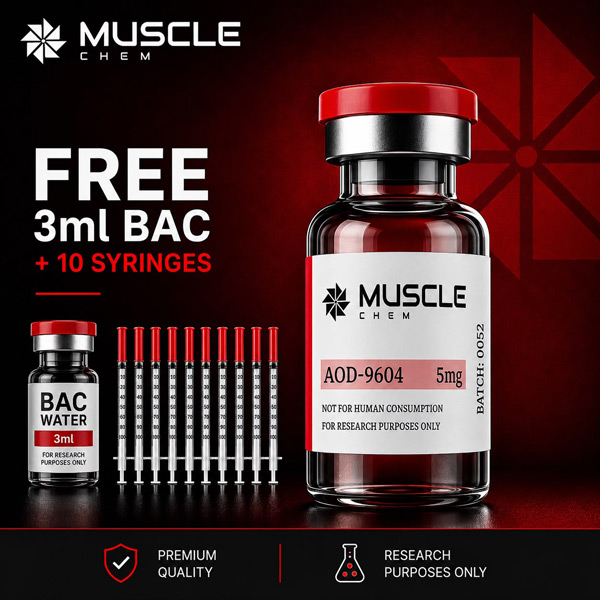
AOD-9604 – 5mg
AOD-9604 is a synthetic peptide fragment derived from the C-terminal region of human growth hormone. It is primarily used to explore fat metabolism, adipocyte signaling, and growth hormone fragment–specific metabolic activity.
- Next-day UK delivery
- Investigation of lipolysis and adipose tissue fat mobilization
- Study of growth hormone fragment–specific metabolic signaling
- Research on hormone-sensitive lipase (HSL) and lipid oxidation pathways
- Evaluation of body composition and energy balance in preclinical models
Original price was: £49.99.£34.99Current price is: £34.99.
| Quantity | Discount |
|---|---|
| Buy 3 | 10% |
| Buy 4 | 12% |
| Buy 5+ | 15% |
- Description
- Reviews (12)
Description
AOD-9604 is a specialized peptide fragment derived from human growth hormone (HGH), researched for its role in fat metabolism. It is designed to promote targeted fat breakdown without influencing blood sugar or growth factors. Preclinical research suggests it may influence adipose tissue metabolism through mechanisms associated with hormone-sensitive lipase (HSL) activity and fat oxidation processes. Unlike intact growth hormone, it does not significantly activate IGF-1 mediated pathways, which distinguishes its functional profile in experimental models.
Originally developed as a research analog of HGH’s lipolytic domain, AOD-9604 has been studied in obesity-related metabolic research and adipose tissue biology. Its investigational profile is largely based on preclinical and translational studies, with no established broad therapeutic approval for weight management or metabolic disease.
Product Specifications
- Peptide: AOD-9604
- Form: Lyophilized Powder
- Strength: 5mg per vial
- Purity: ≥98%
- Storage: Store below -20°C (before reconstitution)
What Is It Used For and Its Purpose
AOD-9604 is primarily used in metabolic and endocrinology research to investigate the specific pathways involved in lipid breakdown and adipose tissue regulation. It is studied as a selective model compound for examining how growth hormone–derived fragments may influence fat metabolism independently of growth-promoting activity.
Mechanistic research focuses on its interaction with lipolytic signaling pathways, including hormone-sensitive lipase activation and downstream fat mobilization processes. It is also used to evaluate whether selective GH-fragment signaling can modulate adipose metabolism without significantly altering insulin or IGF-1 pathways.
- Metabolism (lipid mobilization and energy balance research)
- Endocrinology (growth hormone fragment signaling pathways)
- Adipose tissue biology (fat cell metabolism and lipolysis)
- Receptor signaling (GH-related pathway modulation studies)
- Cardiometabolic research (energy utilization and fat distribution models)
Potential Scientific Benefits
Current scientific evidence for AOD-9604 is primarily derived from preclinical studies, including in vitro systems and animal models, with limited human clinical investigation. Research has focused on its selective lipolytic properties and its potential to influence adipose tissue metabolism without significant effects on IGF-1 or glucose regulation pathways.
Experimental findings suggest that AOD-9604 may promote fat breakdown through mechanisms associated with lipolysis signaling cascades. Unlike full-length growth hormone, it appears not to significantly stimulate linear growth or induce major insulin antagonism in studied models, which has driven interest in its metabolic selectivity.
- Activation of lipolytic pathways associated with adipose tissue metabolism
- Modulation of hormone-sensitive lipase (HSL) activity in preclinical models
- Potential increase in fatty acid mobilization from adipose tissue stores
- Lack of significant IGF-1 stimulation compared with full-length growth hormone
- Investigated metabolic neutrality regarding glucose and insulin pathways in experimental settings
- Effects on body composition observed in animal obesity models
Current evidence remains limited, and further well-controlled clinical studies are required to establish long-term efficacy and safety in humans.
Research Data Sheet
AOD-9604 is a synthetic growth hormone–derived peptide fragment studied in adipose metabolism and lipolysis research models.
- Peptide: AOD-9604
- Classification: Synthetic growth hormone fragment (HGH 176–191 analog)
- Molecular Formula: C990H1529N263O299S7
- Molecular Weight: ~22 kDa
- CAS Number: 12629-01-5
- Form: Lyophilized powder
- Appearance: White to off-white solid
- Purity: ≥99% (research standard)
- Solubility: Soluble in sterile water (research-dependent conditions)
- Storage: 2–8°C short term; -20°C long-term storage recommended
- Research Categories: Metabolism, endocrinology, adipose tissue biology, lipolysis, receptor signaling
Safety Precautions
AOD-9604 is intended strictly for laboratory research use and must be handled only by trained professionals familiar with peptide handling and biochemical research protocols. Due to limited comprehensive human safety data and the investigational nature of this peptide fragment, appropriate laboratory controls and safety practices are required during handling and storage.
- Research use only
- Not for human consumption
- Not intended to diagnose, treat, or prevent disease
- Use appropriate PPE (gloves, lab coat, eye protection)
- Maintain aseptic handling techniques where applicable
- Store under recommended refrigeration conditions
- Avoid repeated freeze–thaw cycles to preserve peptide stability
- Ensure proper labeling and documentation in laboratory environments
- Dispose of materials according to institutional biosafety regulations
- Limited long-term safety and toxicity data in humans
Conclusion
AOD-9604 is a growth hormone–derived peptide fragment that has been widely studied for its selective effects on lipid metabolism and adipose tissue regulation. Its biological relevance is centered on its ability to model GH-associated lipolytic signaling without the full endocrine activity of intact growth hormone.
Research indicates that it may influence fat metabolism through pathways associated with lipolysis and adipose tissue energy mobilization, primarily demonstrated in preclinical models. However, its broader physiological effects and translational relevance in humans remain under investigation. Overall, AOD-9604 is considered a useful research tool for studying metabolic regulation, fat cell biology, and GH-fragment signaling specificity. Its safety and efficacy profile in humans has not been fully established.
Stacks Well With...
-

-
Peptides
IGF-1 LR3 | 1mg (Insulin-like Growth Factor-1)
Original price was: £69.99.£59.99Current price is: £59.99. -
-
-


Ashton V. –
AOD-9604 helped me feel leaner and supported fat metabolism effectively.
Brandon K. –
Noticed better energy and smoother fat loss during my workouts.
Carter L. –
Great for targeting stubborn fat. I feel more toned and defined.
Declan M. –
This peptide really supports metabolism and helps with body composition.
Elias R. –
Saw a reduction in body fat while maintaining muscle. Very happy with results.
Finn T. –
Helps me stay consistent with fat loss. Energy and training performance improved.
Grayson S. –
Effective for supporting lean muscle while reducing excess fat.
Hudson P. –
AOD-9604 boosted my metabolism and helped me achieve a tighter physique.
Ian C. –
Noticeable improvements in body composition and fat reduction. Feels clean and safe.
Jasper D. –
Supports fat loss without affecting energy levels. Very effective peptide.
Kieran W. –
My midsection looks leaner, and workouts feel more productive.
Logan H. –
Helps accelerate fat metabolism and supports lean muscle retention.