BPC-157 + TB-500 in Pen Format — Why the Category Is Getting Attention
Peptide research has moved fast over the last few years, and few combinations have generated as much online discussion as BPC-157 and TB-500. MuscleChem, a UK-based supplier of SARMs and Peptides, now offers this blend in two formats — a traditional lyophilized vial and a newer Pre-filled pen — and the pen option in particular is driving a lot of the current interest. Here’s a breakdown of what the compound blend is, why it’s become such a talked-about topic in research and biohacking circles, and what specifically the pen format changes.
What BPC-157 + TB-500 Actually Is
BPC-157 is a synthetic pentadecapeptide derived from a partial sequence of Body Protection Compound, a protein originally identified in human gastric juice. It has been studied in preclinical models for its potential role in tissue repair, angiogenesis, inflammatory signaling, and connective tissue biology.
TB-500 is a synthetic peptide corresponding to the active region of Thymosin Beta-4 (Tβ4), a naturally occurring protein. Research has focused on its interaction with G-actin and its resulting influence on cytoskeletal organization, cell migration, and tissue remodeling.
Individually, both peptides have a reasonably deep body of preclinical literature behind them. Combined, the rationale is that they may act on complementary regenerative pathways — BPC-157 primarily through nitric oxide and angiogenic signaling, TB-500 through actin dynamics and cell motility. That said, the combined formulation itself has far less published data than either peptide studied alone, and the interaction between the two has not been comprehensively characterized in controlled studies.
Why This Combination Is Trending Right Now
A few factors are converging to keep BPC-157 + TB-500 near the top of peptide-research search trends and forum discussion:
- Crossover interest from sports science and recovery research. Preclinical work on tendon, ligament, and connective tissue repair has made this blend a frequent reference point in discussions about musculoskeletal research, even though that work has been done in animal and in vitro models rather than controlled human trials.
- Broader growth of the peptide research market. Interest in research peptides generally — from growth hormone secretagogues to GLP-1 analogues — has expanded significantly, and BPC-157/TB-500 has ridden that wave as one of the more frequently searched combinations.
- Product format innovation. Historically, peptide research meant lyophilized powder, bacteriostatic water, manual reconstitution, and cold-chain shipping. Suppliers moving to stabilized, pre-filled formats has itself become a talking point, since it removes several of the practical barriers that made peptide research reagents cumbersome to work with.
- Online community discussion. Fitness and biohacking forums, Reddit threads, and YouTube content covering “recovery peptides” continue to reference this stack, which keeps search volume and product page traffic elevated regardless of the underlying evidence base.
What MuscleChem’s Pen Format Changes
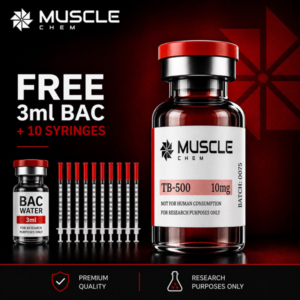
MuscleChem lists the BPC-157 + TB-500 blend in two options: a 10mg lyophilized vial and a 20mg pen. The pen format is built around a few specific product features:
- No reconstitution required. The pen ships pre-prepared, removing the step of measuring bacteriostatic water and manually reconstituting lyophilized powder — a step that’s a common source of dosing inconsistency and contamination risk in a lab setting.
- pH-balanced, stabilized formula. MuscleChem markets the pen as chemically stabilized, intended to maintain peptide integrity without the freeze-thaw sensitivity of standard reconstituted solutions.
- Transit-safe, no ice packs required. Because the formulation is stabilized rather than a freshly reconstituted solution, it’s shipped without the cold-chain packaging that lyophilized peptides typically need — a logistical difference that matters for next-day delivery.
- Standardized concentration. At 20mg per pen, the format gives researchers a fixed, pre-measured quantity, which simplifies inventory and documentation compared with drawing variable volumes from a multi-use vial.
In short, the pen doesn’t change what the peptide blend is — it changes the handling logistics: fewer preparation steps, simpler storage, and more consistent shipping conditions.
Research Applications Cited
MuscleChem lists this blend under several preclinical research categories, consistent with the wider literature on each peptide individually:
- Regenerative medicine
- Musculoskeletal biology
- Angiogenesis research
- Connective tissue biology
- Wound healing and cell migration research
- Inflammation research
- Extracellular matrix biology
Where the Evidence Actually Stands
It’s worth being direct about this: most of what’s cited in favor of BPC-157 and TB-500 comes from animal models and in vitro studies, not controlled human clinical trials. Proposed mechanisms — nitric oxide modulation, VEGF-associated angiogenic signaling, G-actin binding — are reasonably well documented at the preclinical level, but robust human pharmacokinetic, efficacy, and long-term safety data are not currently available for either peptide, and even less so for the combined formulation.
This is precisely why MuscleChem, like other suppliers in this space, sells the product strictly as a laboratory research reagent — not approved for human consumption, veterinary use, diagnostic testing, or therapeutic application. Handling requires appropriate PPE, aseptic technique, and adherence to institutional and regulatory research protocols.
The Bottom Line
The pen format is genuinely a meaningful shift in how peptide research reagents are packaged and shipped — it addresses real friction points around reconstitution, storage, and cold-chain logistics that have long been a headache in this space. That’s the legitimate story behind why MuscleChem’s version is getting attention. The underlying compound blend, however, remains an active but early-stage area of preclinical research, and any claims about its effects in humans go beyond what the current evidence supports.
Disclaimer: This product is intended strictly for laboratory research use. It is not for human consumption and is not intended to diagnose, treat, cure, or prevent any disease.