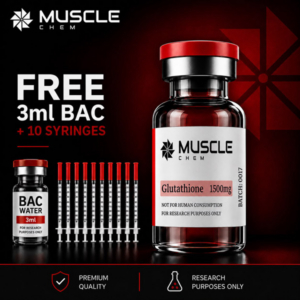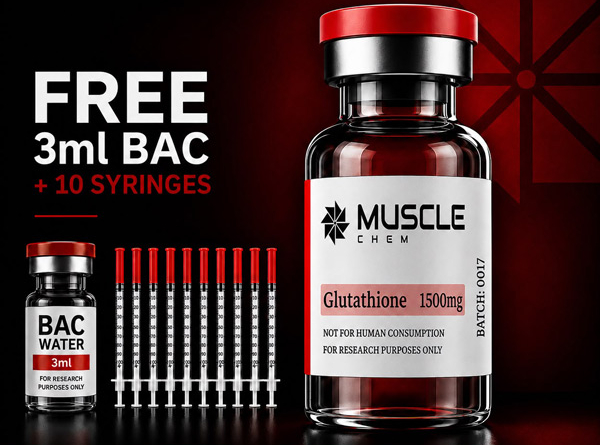
Glutathione 1500mg — The Body’s Master Antioxidant
Among the thousands of molecules studied in modern biochemistry, few command the scientific attention given to Glutathione (GSH). Often referred to as the “master antioxidant,” glutathione is not a synthetic compound engineered in a laboratory — it is an endogenous tripeptide, produced naturally within nearly every cell of the human body. Composed of three amino acids — glutamate, cysteine, and glycine — this small but remarkably powerful molecule sits at the center of cellular defense, detoxification, and redox regulation.
MuscleChem’s Glutathione 1500mg preparation is formulated for researchers investigating the mechanisms that govern oxidative stress, mitochondrial health, immune signaling, and hepatic metabolism. This article takes a deep dive into the science behind glutathione — its structure, biochemical function, and the extensive, multi-layered benefits and advantages that make it one of the most valuable reference molecules in cellular research today.
What Is Glutathione?
Glutathione is a low-molecular-weight tripeptide with the chemical sequence γ-L-Glutamyl-L-cysteinylglycine. It exists in two primary biochemical states:
- Reduced Glutathione (GSH) — the biologically active antioxidant form
- Oxidized Glutathione (GSSG) — formed when GSH donates electrons to neutralize reactive oxygen species (ROS)
The ratio of GSH to GSSG within a cell is one of the most widely used biomarkers of oxidative status in biochemical research. A higher GSH:GSSG ratio generally reflects a well-buffered, antioxidant-rich cellular environment, while a shift toward GSSG is associated with oxidative stress.
Unlike many antioxidants that must be obtained through diet, glutathione is synthesized intracellularly via a two-step enzymatic process involving glutamate-cysteine ligase and glutathione synthetase. This internal production system allows cells to dynamically regulate their antioxidant reserves in response to metabolic demand and environmental stressors.
The Biochemistry Behind the Molecule
At a molecular level, glutathione’s antioxidant capacity stems from the reactive thiol (-SH) group on its cysteine residue. This thiol group is what allows glutathione to donate electrons and neutralize free radicals, effectively “sacrificing” itself to protect more critical cellular structures such as DNA, proteins, and lipid membranes.
Glutathione does not work in isolation. It functions as a cofactor and substrate for several key enzyme systems:
- Glutathione Peroxidases (GPx): Catalyze the reduction of hydrogen peroxide and lipid peroxides, converting them into water and stable alcohols, thereby limiting oxidative chain reactions.
- Glutathione S-Transferases (GST): Facilitate conjugation reactions that are central to Phase II detoxification, helping cells process and neutralize a range of endogenous and exogenous compounds.
- Glutathione Reductase: Regenerates reduced GSH from oxidized GSSG using NADPH, maintaining a continuous antioxidant cycle within the cell.
Together, these enzymatic systems form what researchers refer to as the “glutathione redox cycle” — a self-sustaining loop that allows cells to continuously buffer oxidative insults without depleting their antioxidant reserves.
Product Specifications
| Attribute | Detail |
| Peptide Name | Glutathione (Reduced Glutathione; GSH) |
| Classification | Endogenous tripeptide antioxidant |
| Sequence | γ-L-Glutamyl-L-cysteinylglycine |
| Molecular Formula | C₁₀H₁₇N₃O₆S |
| Molecular Weight | 307.32 g/mol |
| CAS Number | 70-18-8 |
| PubChem CID | 124886 |
| ChemSpider ID | 111885 |
| ChEMBL ID | CHEMBL15497 |
| Form | Research-grade glutathione powder |
| Strength | 1500 mg |
| Appearance | White to off-white crystalline powder |
| Solubility | Soluble in water (formulation-dependent) |
| Storage | Protect from moisture, heat, and light per supplier guidance |
| Regulatory Status | Research compound; varies by jurisdiction |
Research Applications and Purpose
Glutathione is one of the most heavily referenced molecules in redox biology literature, serving as a foundational model compound for understanding how cells manage oxidative balance. Researchers utilize glutathione to explore:
- Oxidative stress mechanisms — how ROS accumulate and how cells counteract them
- Cellular redox biology — the broader signaling networks tied to thiol chemistry
- Mitochondrial function — since mitochondria are both major ROS producers and highly glutathione-dependent organelles
- Enzyme kinetics and biochemistry — particularly GPx and GST activity
- Detoxification pathways — Phase II hepatic metabolism and xenobiotic processing
- Liver metabolism — glutathione depletion is a classic marker in hepatotoxicity studies
- Immunology — glutathione status influences lymphocyte proliferation and cytokine regulation
- Aging biology — declining intracellular GSH levels are frequently studied in relation to cellular senescence
- Molecular stress response studies — how cells upregulate antioxidant defenses under duress
- Antioxidant signaling research — including Nrf2 pathway activation, a master regulator of antioxidant gene expression
Because glutathione is involved in so many interconnected pathways, it serves as a valuable reference point across disciplines — from toxicology to gerontology to sports science research.
In-Depth Benefits and Advantages of Glutathione in Research
Glutathione’s reputation as the “master antioxidant” is not incidental — it stems from a dense web of interconnected biochemical roles that few other molecules replicate. Below is an expanded, mechanism-by-mechanism breakdown of the benefits and advantages researchers associate with glutathione at the cellular level.
1) Central Hub of Cellular Antioxidant Defense
Unlike antioxidants that act through a single mechanism, glutathione operates through multiple, overlapping defense layers:
- Direct radical scavenging — the thiol group on cysteine directly neutralizes reactive oxygen and nitrogen species (ROS/RNS), including hydroxyl radicals and peroxynitrite.
- Enzymatic amplification — glutathione serves as the essential substrate for glutathione peroxidase, meaning its antioxidant reach is multiplied through enzymatic catalysis rather than limited to stoichiometric, one-to-one neutralization like many dietary antioxidants (e.g., vitamin C).
- Recycling of other antioxidants — research indicates glutathione helps regenerate oxidized forms of vitamin C and vitamin E, effectively extending the working lifespan of the body’s broader antioxidant network.
This layered defense system is a key reason glutathione is studied not just as an antioxidant itself, but as a coordinator of overall cellular antioxidant capacity.
2) Mitochondrial Protection and Bioenergetic Support
Mitochondria are simultaneously the primary generators of ATP and the primary source of ROS production within the cell, making them uniquely vulnerable to oxidative damage. Research has focused heavily on glutathione’s role here:
- Mitochondria maintain their own dedicated glutathione pool, separate from cytosolic glutathione, underscoring its importance to organelle-specific defense.
- Depletion of mitochondrial glutathione has been linked in laboratory models to impaired oxidative phosphorylation, reduced ATP output, and increased susceptibility to apoptotic signaling.
- Preservation of mitochondrial GSH levels is studied as a potential mechanism for supporting mitochondrial membrane integrity and metabolic efficiency under stress conditions.
This makes glutathione a frequent focus in bioenergetics and mitochondrial dysfunction research, particularly in models examining metabolic stress and cellular aging.
3) Hepatic Detoxification and Phase II Metabolism
The liver contains some of the highest concentrations of glutathione in the body, reflecting its central role in detoxification biology:
- Glutathione S-transferase enzymes use GSH to conjugate a wide variety of electrophilic compounds, rendering them more water-soluble and easier for the body to eliminate.
- This conjugation process is a cornerstone of Phase II xenobiotic metabolism, working downstream of Phase I cytochrome P450 reactions.
- Hepatic glutathione depletion is one of the most well-documented markers of oxidative liver stress in toxicology research, making GSH levels a key variable in hepatotoxicity and drug-metabolism studies.
Because of this, glutathione is considered an essential reference molecule for researchers studying liver detoxification capacity and chemical or metabolic stress responses.
4) Protection of Proteins, Lipids, and DNA
Oxidative damage to macromolecules is a central concern in aging and disease-related research, and glutathione’s protective reach extends across all three major biomolecule classes:
- Proteins: Glutathione helps maintain proper protein thiol status through a process called glutathionylation, which protects cysteine residues from irreversible oxidative damage and helps preserve protein structure and function.
- Lipids: By supporting glutathione peroxidase activity, GSH helps limit lipid peroxidation chain reactions, which are studied extensively in the context of cellular membrane integrity and neurodegenerative research models.
- DNA: Reduced oxidative burden on nuclear and mitochondrial DNA is associated with lower rates of oxidative DNA lesions in preclinical models, an area of ongoing interest in aging and genomic stability research.
5) Modulation of Redox-Sensitive Signaling Pathways
Beyond its role as a direct antioxidant, Glutathione is increasingly studied for its influence on cellular signaling:
- Nrf2/Keap1 pathway: Glutathione status influences the activation of Nrf2, a transcription factor that upregulates a broad panel of antioxidant and detoxification genes. This makes GSH not just a passive antioxidant, but an active participant in the cell’s adaptive stress response.
- NF-κB signaling: Redox balance, heavily influenced by glutathione, is studied in relation to inflammatory signaling cascades, given that NF-κB activity is sensitive to the cellular oxidative environment.
- Apoptotic signaling: Glutathione depletion is a well-documented trigger in several apoptosis models, suggesting a regulatory role in determining cell survival versus programmed cell death under oxidative stress.
6) Immune System Regulation
Glutathione status has a documented relationship with immune cell function in laboratory research:
- Lymphocyte proliferation and activation have been shown in cellular models to be sensitive to intracellular glutathione concentrations.
- Antigen-presenting cell function and cytokine production patterns (including shifts between Th1 and Th2 responses) have been studied in relation to redox balance.
- Because immune cells generate significant oxidative burden during activation (e.g., respiratory burst in phagocytes), adequate glutathione buffering is considered important for sustaining immune cell viability during active immune responses.
7) Relevance to Aging and Cellular Senescence Research
Age-related decline in intracellular glutathione is one of the most consistently reported findings across species and tissue types in aging biology:
- Lower GSH:GSSG ratios have been observed in various aged tissue models, correlating with increased markers of oxidative damage.
- Glutathione metabolism is studied as part of the broader “free radical theory of aging,” which links cumulative oxidative damage to functional decline at the cellular level.
- Researchers use glutathione depletion and repletion models to study how redox status influences cellular senescence markers and stress resilience over time.
8) Versatility as a Research Tool
Beyond its direct biological roles, Glutathione offers practical advantages as a research compound:
- Well-characterized chemistry — decades of analytical data make it a reliable, reproducible reference standard in redox assays.
- Broad tissue relevance — its presence and function across liver, immune, neural, and muscular tissue make it applicable to a wide range of experimental models.
- Dual functionality — few molecules serve simultaneously as both a direct antioxidant and a detoxification cofactor, allowing researchers to study two major cellular defense systems using a single compound.
- Established biomarker status — the GSH:GSSG ratio remains one of the most widely accepted proxies for oxidative stress in published literature, giving researchers a standardized metric for comparison across studies.
Summary of Advantages at a Glance
| Advantage Category | Key Research Relevance |
| Antioxidant defense | Direct ROS scavenging + enzymatic amplification via GPx |
| Mitochondrial support | Maintains dedicated mitochondrial GSH pool; linked to ATP production |
| Detoxification | Central to Phase II hepatic conjugation reactions |
| Macromolecule protection | Shields proteins, lipids, and DNA from oxidative damage |
| Signaling modulation | Influences Nrf2, NF-κB, and apoptotic pathways |
| Immune regulation | Affects lymphocyte function and cytokine balance |
| Aging biology | GSH decline linked to oxidative damage accumulation |
| Research utility | Reliable biomarker (GSH:GSSG ratio) and reproducible reference compound |
It’s important to note that while these findings are compelling at the preclinical and cellular level, current evidence remains limited when it comes to established clinical applications. Well-controlled, long-term human trials are still needed to draw definitive conclusions about efficacy and safety across specific use cases.
Research Data Sheet
| Field | Information |
| Compound Name | Glutathione (Reduced Glutathione; GSH) |
| Sequence | γ-L-Glutamyl-L-cysteinylglycine |
| Classification | Endogenous tripeptide antioxidant |
| Molecular Formula | C₁₀H₁₇N₃O₆S |
| Molecular Weight | 307.32 g/mol |
| CAS Number | 70-18-8 |
| PubChem CID | 124886 |
| ChemSpider ID | 111885 |
| ChEMBL ID | CHEMBL15497 |
| Form | Powder (research preparation dependent) |
| Appearance | White to off-white crystalline powder |
| Storage | Per supplier specifications; protect from moisture and degradation |
| Research Categories | Antioxidant Biology, Redox Biology, Molecular Biochemistry, Mitochondrial Research, Cellular Stress Research, Metabolism |
Safety Precautions
Glutathione 1500mg is supplied strictly for laboratory research purposes. Even though glutathione is naturally present in human physiology, research-grade material must be handled with the same rigor as any other biochemical compound to preserve integrity and ensure reliable experimental outcomes.
- Research use only
- Not for human consumption
- Not intended to diagnose, treat, cure, or prevent any disease
- Wear appropriate personal protective equipment (gloves, lab coat, eye protection)
- Follow aseptic handling procedures where applicable
- Store according to supplier recommendations, protected from moisture, heat, and light
- Avoid repeated freeze–thaw cycles when applicable
- Maintain proper labeling, batch tracking, and documentation
- Dispose of materials in accordance with institutional and regulatory guidelines
- Human safety data are context- and route-dependent; long-term effects of specific research applications remain under active investigation
Conclusion
Glutathione stands as one of biochemistry’s most extensively studied endogenous molecules — a tripeptide with outsized influence over cellular antioxidant defense, redox regulation, and detoxification biology. Its benefits extend across an unusually wide range of biological systems: from direct radical scavenging and mitochondrial protection to hepatic detoxification, immune regulation, and its documented decline in aging models. Few compounds offer researchers this breadth of interconnected mechanisms within a single, well-characterized molecule.
Glutathione 1500mg provides a high-purity research-grade option for laboratories investigating oxidative stress, mitochondrial function, hepatic metabolism, immune regulation, and aging biology. While preclinical findings continue to expand our understanding of glutathione’s mechanisms, further controlled human research is necessary to fully translate these insights into clinical application. As research into cellular redox biology continues to evolve, glutathione remains a foundational molecule — bridging biochemistry, physiology, and pharmacology in the ongoing effort to understand how cells protect themselves against the constant challenge of oxidative stress.
Disclaimer: For research purposes only. Not for human consumption. Not intended to diagnose, treat, cure, or prevent any disease.