KPV 10mg — Disadvantages, Safety Concerns and Red Flags
KPV, also known as Lys-Pro-Val, is a small tripeptide derived from the C-terminal sequence of alpha-melanocyte-stimulating hormone (α-MSH). It has attracted scientific interest because laboratory and animal studies have investigated its potential effects on inflammatory signaling, intestinal epithelial biology, NF-κB and MAPK pathways, cytokine production, and PepT1-mediated peptide transport.
However, interest in KPV should not be confused with established clinical safety or proven therapeutic effectiveness. The most important issue surrounding KPV 10mg is the limited amount of high-quality human evidence. Much of the research supporting KPV’s biological activity comes from cellular and animal models rather than large, well-controlled human clinical trials. Broader reviews of peptide use also highlight that many newer research peptides carry limited clinical evidence, poorly defined long-term risks, and potential product-quality concerns in unregulated supply chains. For this reason, anyone researching KPV should weigh both what the experimental literature suggests and what remains unknown.
What Is KPV?
KPV stands for Lys-Pro-Val, a three-amino-acid peptide sequence corresponding to the C-terminal region of α-MSH. Research has investigated KPV because experimental studies have reported anti-inflammatory activity. One study found that KPV affected NF-κB and MAPK inflammatory signaling and reduced pro-inflammatory cytokine secretion in intestinal epithelial and immune-cell models. The same research investigated KPV in mouse models of colitis and identified PepT1 as a mechanism involved in cellular uptake. These findings explain why KPV is being studied, but they do not establish it as a clinically proven treatment — a distinction that matters throughout the rest of this article.
The Biggest Disadvantage: Limited Human Evidence
KPV’s core limitation is not a specific side effect that’s been conclusively demonstrated in humans — it’s the lack of sufficient human safety and efficacy data. KPV has generated promising findings in experimental models, but these models cannot fully predict what happens in people.
Animal and cell studies can help researchers understand molecular signaling, cellular responses, potential mechanisms of action, tissue-specific effects, preliminary toxicity, and pharmacological properties. But they cannot establish the complete human safety profile.
For KPV, important questions remain regarding:
- Long-term exposure
- Appropriate clinical dosing
- Human pharmacokinetics
- Drug interactions
- Effects in people with chronic diseases
- Effects in pregnancy or breastfeeding
- Effects in children and older adults
- Repeated exposure over months or years
- Individual differences in response
The absence of documented serious adverse effects in preclinical research should not be interpreted as proof that KPV is completely safe in humans.
A Research Compound, Not an Established Medicine
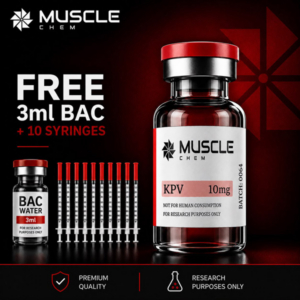
Another important distinction is between a research peptide and an approved pharmaceutical. The MuscleChem product is presented as KPV 10mg for research purposes, described as a synthetic tripeptide and research compound rather than an approved therapeutic medication.
This means consumers should not automatically apply claims from experimental studies to personal medical use. An experimental peptide can demonstrate an interesting biological effect in a laboratory while still being unsuitable for routine human treatment — especially with KPV, where much of the literature concerns experimental inflammatory models rather than large human clinical trials.
Red Flags to Watch For:
Red Flag #1:
Claims that KPV is “proven” to treat inflammation. Research shows KPV can influence inflammatory signaling under experimental conditions — inhibiting NF-κB and MAPK pathways and reducing cytokine secretion in lab models, with effects also reported in mouse colitis models. That is not the same as a clinically effective human treatment. Be wary of claims like “KPV cures inflammation,” “treats autoimmune disease,” “permanently fixes gut inflammation,” “is clinically proven for IBD,” or “replaces prescription anti-inflammatory medication.” A more accurate statement: KPV is being investigated for its potential to modulate inflammatory pathways in preclinical models.
Red Flag #2:
Assuming animal results guarantee human benefits. Mouse studies showing reduced inflammatory markers provide reason for further research — they don’t establish an effective human dose, long-term human safety, real-world treatment effectiveness, appropriate duration, or individual patient suitability.
Red Flag #3:
Lack of long-term safety data. A compound can appear well tolerated in short studies while its effects after prolonged exposure remain unknown. For KPV, researchers still need more information on whether repeated, long-term exposure could affect immune signaling, cellular pathways, gastrointestinal function, other peptide transport mechanisms, or drug metabolism. Recent reviews of emerging peptide therapies emphasize that many novel peptides need substantially more research before human safety can be established.
Red Flag #4:
Product purity and quality. A product’s chemical identity and the quality of a specific batch are separate questions. Even a product labeled KPV requires confidence around peptide identity, purity, concentration, stability, contamination, and manufacturing and storage conditions. A label alone doesn’t establish that a product contains exactly what it claims — a concern that extends across the broader, largely unregulated peptide supply market, where mislabeling and contamination risks have been noted.
Red Flag #5:
Confusing purity with safety. Purity only answers what’s present in the product. It does not answer questions about human safety, appropriate exposure, clinical efficacy, long-term effects, or individual susceptibility. Statements like “99% pure, therefore completely safe” are scientifically misleading.
Red Flag #6:
Assuming “natural origin” means risk-free. Because KPV originates from a sequence associated with the naturally occurring α-MSH, some marketing may imply inherent safety. That conclusion isn’t justified — a naturally occurring biological sequence can have very different effects depending on concentration, route of exposure, formulation, duration, and individual physiology.
Red Flag #7:
Overstating KPV’s anti-inflammatory mechanism. Research has shown effects involving NF-κB and MAPK signaling and identified PepT1 as a transporter involved in uptake — but biological systems are complex, and a lab observation on one pathway doesn’t guarantee a predictable clinical outcome. Descriptions like “KPV blocks inflammation by switching off NF-κB” oversimplify the evidence.
Red Flag #8:
Assuming KPV has no side effects. The absence of an extensively documented adverse-effect profile in humans isn’t evidence of no risk — it means the evidence is insufficient to accurately quantify risk. “No established human safety profile” does not mean “no risk.”
Red Flag #9:
Unsupervised use based on online protocols. Online forums and social media may share dosing schedules, peptide combinations, reconstitution practices, or administration methods that haven’t been evaluated in controlled studies. Combining multiple experimental peptides makes it even harder to determine which compound caused an effect or adverse reaction, or whether interactions occurred — adding real uncertainty for a compound with limited human data.
Red Flag #10:
Claims that KPV can replace medical treatment. Someone with persistent gastrointestinal or skin symptoms shouldn’t assume an experimental peptide can substitute for proper diagnosis of conditions like IBD, infection, or food intolerance. An experimental peptide should never be a reason to delay evidence-based medical care.
Disadvantages at a Glance
- Limited human clinical data — most evidence comes from preclinical research
- Unknown long-term safety — repeated human exposure hasn’t been adequately studied
- Uncertain clinical effectiveness — promising lab results don’t equal proven efficacy
- Product quality concerns — quality varies, especially without independent analytical documentation
- Unknown individual responses — outcomes may vary by health status and other factors
- Limited interaction data — no comprehensive human interaction profile exists
- Regulatory limitations — KPV is a research compound, not an approved medicine
- Risk of misleading marketing — online claims often outpace the actual evidence
- Lack of standardized protocols — no established clinical framework for human use
- Uncertain risk-benefit balance — without human trials, this can’t be reliably assessed
Does KPV Have Known Serious Side Effects?
It’s important not to present a list of specific serious side effects as if they were clinically established when they aren’t. For KPV, the more accurate concern is that the human safety database itself is limited. Some sources may publish extensive “side effect” lists as though clinically confirmed — these should be treated cautiously unless traceable to reliable human research. The literature currently says far more about KPV’s experimental biological activity than about its long-term human safety.
Injection-Related Risks
KPV itself should be distinguished from risks tied to a particular method of administration. If a research peptide is handled or injected improperly, additional risks can arise independent of KPV’s molecular activity — including contamination, infection, incorrect handling, product degradation, sterility problems, local tissue reactions, and dosing errors. Research peptides shouldn’t be assumed to meet the same safety standards as approved, sterile pharmaceutical products.
KPV and Competitive Sports
Reviews of peptide use in sport have identified KPV among compounds promoted in bodybuilding and performance-enhancement settings, alongside concerns about limited clinical evidence and unregulated supply chains. Athletes subject to anti-doping rules should independently verify current prohibited-substance rules with their sport’s governing body — being sold online as a “research peptide” doesn’t mean it’s permitted in competition.
How to Recognize Questionable KPV Marketing
Be cautious of absolute language such as:
- “100% safe” — no responsible source can establish universal safety for an inadequately studied peptide
- “Zero side effects” — limited safety data cannot establish zero risk
- “Clinically proven” — check whether it’s backed by controlled human trials specific to KPV
- “FDA approved treatment” — verify directly with the relevant regulator, not marketing copy
- “Cures IBD” — preclinical mouse/cell findings don’t establish a human cure
- “Works for everyone” — individual response can’t be predicted from current evidence
- “No medical supervision required” — especially concerning for an experimental compound
- “No need for conventional treatment” — this can encourage delaying appropriate care
How to Evaluate a KPV Research Product
Look beyond the product name and ask:
- Is the peptide clearly identified as KPV or Lys-Pro-Val, with relevant product information?
- Is there batch-specific documentation, such as a certificate of analysis?
- Is the intended research use clearly and separately stated from medical claims?
- Are storage requirements provided, given peptides’ sensitivity to environmental conditions?
- Is the supplier transparent, with clear documentation rather than unsupported health claims?
What the Science Supports — and What It Does Not
Supported by experimental research:
NF-κB signaling, MAPK signaling, inflammatory cytokine regulation, intestinal epithelial biology, PepT1-mediated peptide transport, experimental intestinal inflammation models, and general peptide pharmacology — with the strongest evidence coming from lab and animal research.
Not established: long-term human safety, a clinically validated therapeutic dose, proven treatment of human inflammatory disease, long-term effects of repeated human exposure, comprehensive human drug interactions, or broad clinical effectiveness.
KPV 10mg: Research Product Information
The MuscleChem’s offered product is presented as KPV 10mg, a research peptide based on the Lys-Pro-Val sequence:
- Name: KPV
- Sequence: Lys-Pro-Val
- Classification: Synthetic tripeptide
- Origin: C-terminal sequence associated with α-MSH
- Quantity: 10mg
- Research area: Inflammation and peptide biology
- Form: Lyophilized research peptide
The product should be evaluated as a research compound, not treated as equivalent to an approved pharmaceutical.
Frequently Asked Questions
What is the biggest disadvantage of KPV? The lack of sufficient human clinical evidence, particularly on long-term safety and therapeutic effectiveness.
Is KPV proven safe? No — there isn’t enough human evidence to establish a comprehensive safety profile.
Does KPV definitely cause side effects? Specific human side effects can’t be confidently characterized from current evidence. Insufficient data means “no known risk” shouldn’t be read as “risk-free.”
Is KPV an approved medicine? No — it’s a research peptide and shouldn’t be represented as an approved therapeutic.
Is KPV proven to treat gut inflammation? No. Studies in intestinal cells and mouse colitis models show effects on NF-κB, MAPK, and cytokine signaling, but this doesn’t establish a treatment for human IBD.
Is KPV the same as a SARM? No — KPV is a synthetic tripeptide, not a selective androgen receptor modulator.
Should “99% purity” be considered proof of safety? No — purity and clinical safety are separate issues; a pure compound can still lack adequate human safety data.
Conclusion
KPV is an interesting research peptide with substantial experimental interest, particularly given its identified effects on NF-κB signaling, MAPK pathways, inflammatory cytokines, and PepT1-mediated intestinal transport. However, the disadvantages and red flags are equally important: limited human evidence, uncertain long-term safety, lack of standardized clinical protocols, uncertain drug interactions, product-quality considerations, and the risk of exaggerated online marketing claims.
Current science supports continued investigation of KPV — it does not justify presenting the peptide as a proven human treatment. For responsible research communication, KPV should be described as what the evidence actually shows: a synthetic α-MSH-derived tripeptide being investigated for effects on inflammatory and cellular pathways, with important gaps remaining in human safety and clinical efficacy data.
Disclaimer: KPV is intended for laboratory research purposes only. It is not an approved human therapeutic and should not be represented as a treatment, cure, or prevention for any disease. Human safety and long-term effects remain insufficiently characterized.