SNAP-8 (5mg) — Top 10+ Benefits and Research Applications
Among the newer generation of biomimetic peptides used in dermatological and skin-biology research, SNAP-8 has emerged as one of the most closely studied. Developed as an elongated analog of acetyl hexapeptide-8, SNAP-8 was engineered to mimic the N-terminal region of SNAP-25 (Synaptosomal-Associated Protein 25) — a core component of the SNARE complex responsible for regulating calcium-dependent neurotransmitter release at neuronal synapses.
Unlike botulinum-derived neuromodulators, which act enzymatically and produce prolonged, injection-based neuromuscular blockade, SNAP-8 is non-enzymatic and has been investigated almost exclusively as a topical research compound. Its appeal to researchers lies in a dual mechanism: partial modulation of neurotransmitter release pathways on one hand, and potential influence over dermal fibroblast activity and extracellular matrix remodeling on the other. This combination has made SNAP-8 a peptide of considerable interest across cosmetic science, skin-aging biology, and neuroexocytosis research.
Below is a detailed, research-oriented look at the top benefits associated with SNAP-8 (5mg), along with its mechanism of action, physiological pathways, and safety considerations for laboratory use.
What Is SNAP-8?
SNAP-8 is a synthetic biomimetic peptide with the reported sequence Acetyl Ac-Glu-Glu-Met-Gln-Arg-Arg-Ala-Asp-NH₂. It is typically supplied as a lyophilized, research-grade powder that must be stored under refrigeration or freezing to preserve peptide stability. As an elongated version of acetyl hexapeptide-8 (Argireline), SNAP-8 was designed with additional amino acid residues intended to enhance its interaction with SNARE complex proteins, giving it a distinct research profile from its shorter predecessor.
Because SNAP-8 has been evaluated primarily in cosmetic formulation studies rather than pharmaceutical trials, its classification remains that of a research and cosmetic ingredient — it is not approved as a therapeutic drug, and it is not intended to diagnose, treat, or prevent any disease.
Top 10+ Benefits and Research Findings on SNAP-8
1) Modulation of SNARE Complex Assembly
The defining feature of SNAP-8 is its capacity to partially interfere with SNARE complex assembly, the molecular machinery responsible for synaptic vesicle fusion. By mimicking a segment of SNAP-25, the peptide is thought to competitively engage with proteins involved in this process, offering researchers a tool to study SNARE-dependent exocytosis without the enzymatic, long-lasting action seen with botulinum-derived compounds.
2) Reduced Neurotransmitter Release in Experimental Models
Because SNARE assembly underlies calcium-dependent neurotransmitter release, SNAP-8’s interference with this complex has been linked in laboratory models to reduced efficiency of neurotransmitter release at peripheral nerve endings. This effect is of particular interest to researchers studying neuroexocytosis mechanisms and reversible, non-enzymatic modulation of neuromuscular signaling.
3) A Reversible Alternative Mechanism to Enzymatic Neuromodulators
Unlike botulinum neurotoxins, which cleave SNAP-25 enzymatically to produce prolonged blockade, SNAP-8 works through a non-enzymatic, partial-interference mechanism. Researchers studying dose-dependent or reversible modulation of neuromuscular signaling have used this distinction as a basis for comparative studies between peptide-based and enzyme-based approaches.
4) Support for Dermal Fibroblast Activity
Preclinical studies have explored whether SNAP-8 exposure influences dermal fibroblast behavior. Some laboratory findings report increased fibroblast activity following exposure, positioning the peptide as a research tool for studying the cellular drivers of skin structure and repair.
5) Potential Influence on Type I Collagen Production
A recurring theme across preclinical investigations is SNAP-8’s possible role in regulating collagen metabolism. Laboratory findings suggest the peptide may influence fibroblast-mediated type I collagen synthesis, with some studies reporting improved collagen organization. These findings remain preliminary, and the exact molecular pathway connecting SNARE modulation to collagen regulation is still under investigation.
6) Extracellular Matrix (ECM) Remodeling Research
Beyond collagen alone, SNAP-8 has been studied in the broader context of extracellular matrix turnover and dermal connective tissue remodeling. This makes it relevant to researchers investigating the structural components of skin aging, not merely surface-level appearance changes.
7) Reported Reductions in Wrinkle Appearance in Cosmetic Studies
Limited human cosmetic studies evaluating topical formulations containing SNAP-8 or closely related biomimetic peptides have reported reductions in the appearance of facial wrinkles after several weeks of repeated application. It’s important to note these are cosmetic outcome studies rather than controlled pharmacological trials, and formulation differences make cross-study comparisons difficult.
8) Improvements in Skin Hydration Parameters
Experimental work has also examined SNAP-8’s relationship to skin hydration. Selected studies report measurable improvements in hydration parameters following topical application, contributing to interest in the peptide as a research tool for skin barrier and moisture-retention studies.
9) Enhanced Skin Elasticity Measurements
In addition to hydration, some cosmetic research has reported improved skin elasticity measurements in models and limited human studies. This is thought to be connected to the peptide’s potential effects on collagen organization and fibroblast activity, though reproducibility across independent studies remains an active area of investigation.
10) Sebum Regulation Research
Some experimental work has explored whether SNAP-8 exposure is associated with changes in sebum production, adding a further dimension to its relevance for researchers studying broader skin physiology and oil regulation pathways.
11) A Valuable Tool for Neuroexocytosis Research
Because of its structural relationship to SNAP-25, SNAP-8 continues to serve as an experimental tool for studying neuroexocytosis and synaptic vesicle fusion more generally — independent of its cosmetic applications. This makes it useful in neurobiology research settings that are exploring calcium-dependent exocytosis mechanisms.
12) Applications Across Multiple Research Disciplines
Taken together, SNAP-8’s dual mechanism — partial SNARE modulation plus potential ECM and fibroblast effects — makes it applicable across a wide range of research categories, including:
- Dermatological research
- Skin aging biology
- Extracellular matrix research
- Fibroblast biology
- Collagen metabolism
- Neuropeptide signaling
- SNARE complex biology
- Neuroexocytosis research
- Cosmetic peptide development
- Tissue remodeling research
Reported Molecular Mechanisms
Research to date points to several proposed mechanisms underlying SNAP-8’s observed effects:
- Interaction with SNARE protein assembly
- Modulation of calcium-dependent exocytosis
- Influence on extracellular matrix remodeling
- Potential regulation of fibroblast-mediated collagen synthesis
Physiological Pathways Involved
- Neuroexocytosis
- Synaptic vesicle fusion
- Extracellular matrix turnover
- Dermal connective tissue remodeling
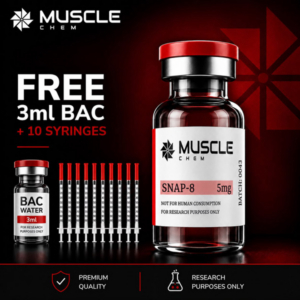
Product Specifications: SNAP-8 – 5mg
| Attribute | Detail |
| Peptide Name | SNAP-8 |
| Classification | Synthetic biomimetic peptide |
| Sequence | Acetyl Glu-Glu-Met-Gln-Arg-Arg-Ala-Asp-Asn-Leu-Gly-Pro-Gly-Pro-Arg-NH₂ |
| Form | Research-grade, lyophilized peptide powder |
| Strength | 5mg |
| Purity | As provided by supplier |
| Storage | Refrigerated or frozen to preserve stability; avoid repeated freeze–thaw cycles |
| Solubility | Research-dependent |
| Regulatory Status | Research and cosmetic ingredient; not approved as a therapeutic drug |
Safety Precautions
SNAP-8 is supplied strictly as a research material and should be handled only by trained laboratory personnel following standard laboratory practices. Because published safety information is derived primarily from topical cosmetic studies, comprehensive toxicological data for broader laboratory applications remain limited. Recommended handling practices include:
- Research use only — not for human consumption
- Not intended to diagnose, treat, or prevent disease
- Wear gloves, a laboratory coat, and eye protection
- Use aseptic handling procedures during preparation
- Store according to supplier recommendations
- Avoid repeated freeze–thaw cycles
- Maintain proper labeling and documentation
- Dispose of materials per institutional and regulatory waste procedures
Human safety data remain limited, and the long-term biological effects of SNAP-8 have not been fully characterized.
Conclusion
SNAP-8 stands out among biomimetic peptides for its dual research relevance: as a tool for studying SNARE-mediated neurotransmitter release, and as a candidate ingredient in cosmetic formulations investigating fibroblast activity, collagen metabolism, skin hydration, and tissue elasticity. While cosmetic studies have reported encouraging outcomes — including reduced wrinkle appearance and improved elasticity — the underlying molecular mechanisms are still being mapped, and current evidence is strongest for cosmetic research applications rather than therapeutic use. Further well-controlled clinical studies are needed to establish long-term efficacy and safety in humans.
For laboratories and researchers investigating skin aging biology, neuroexocytosis, or extracellular matrix remodeling, SNAP-8 (5mg) remains a valuable and versatile research peptide.
Disclaimer: This product is intended strictly for laboratory research use. It is not for human consumption and is not intended to diagnose, treat, cure, or prevent any disease.