Glow Blend — Why Pen Technology Is Trending and How It Could Transform Peptide Research
The Peptide industry is entering an increasingly technology-driven phase. While traditional peptide research has commonly relied on lyophilised vials and laboratory reconstitution workflows, newer delivery concepts are attracting significant attention because they aim to simplify handling, improve consistency and create a more convenient format for peptide-based research.
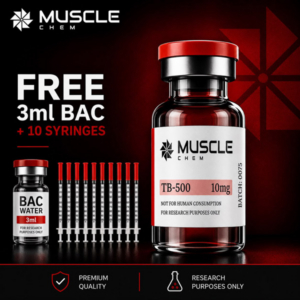
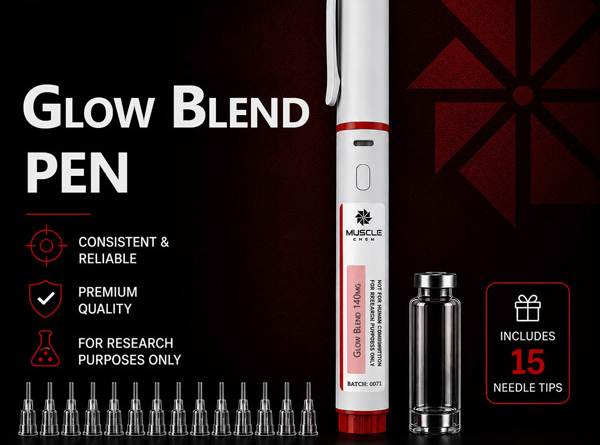
One of the formulations generating interest is Glow Blend, a multi-peptide research formulation combining BPC-157, TB-500 and GHK-Cu. MuscleChem currently describes its Glow Blend as a 70 mg regenerative research complex containing 10 mg BPC-157, 10 mg TB-500 and 50 mg GHK-Cu. The product is positioned for research involving tissue repair, wound-healing biology, collagen and extracellular-matrix regulation, inflammation-related pathways and regenerative biology. The next major development is not simply the peptide blend itself, however. It is the delivery technology surrounding peptides.
The concept of placing peptide formulations into Pen-style systems is becoming increasingly interesting because a pen can potentially transform how a peptide formulation is stored, handled, measured and delivered within an appropriate research or pharmaceutical environment.
What Is Glow Blend?
Glow Blend is a multi-peptide research formulation built around three compounds with different but potentially complementary biological research profiles:
According to MuscleChem, the formulation is designed as a research model for investigating interconnected biological processes including tissue repair, angiogenesis-related signalling, cellular migration, extracellular-matrix remodelling, collagen biology, inflammation modulation and oxidative-stress pathways. The attraction of a combination formulation is the possibility of studying several biological pathways within a single experimental framework rather than examining every compound independently.
However, an important scientific distinction must be made: the existence of biological activity for individual peptides does not automatically prove that the combination produces a clinically meaningful synergistic effect in humans. MuscleChem itself notes that evidence surrounding the combined formulation remains predominantly preclinical and that the combined effects require further controlled research.
That distinction is important when discussing Glow Blend professionally.
The Three Peptides Behind Glow Blend
1) BPC-157
BPC-157 is an experimental peptide that has attracted considerable interest in regenerative biology research. Research models have investigated BPC-157 in connection with:
- Tissue-repair signalling
- Angiogenesis-related pathways
- Cellular protection
- Fibroblast activity
- Inflammatory signalling
- Gastrointestinal and musculoskeletal research
The scientific interest surrounding BPC-157 largely comes from its observed biological activity in experimental models. It should not, however, be presented as an established human treatment. Much of the available evidence remains preclinical.
2) TB-500
TB-500 is associated with research into thymosin-beta-4-related biological mechanisms, particularly pathways involving cellular movement and structural remodelling. Research interest includes:
- Cellular migration
- Actin cytoskeleton dynamics
- Tissue remodelling
- Regenerative processes
- Angiogenesis-related mechanisms
- Cellular recovery
From a research perspective, TB-500 is particularly interesting because cellular migration and cytoskeletal organisation are fundamental components of tissue repair.
3) GHK-Cu
GHK-Cu is a copper-binding peptide that has been extensively investigated in skin and connective-tissue research. Its research relevance includes:
- Collagen synthesis
- Extracellular-matrix regulation
- Antioxidant defence
- Gene-expression regulation
- Skin biology
- Tissue-repair signalling
Within Glow Blend, GHK-Cu represents the largest component of the formulation at 50 mg, compared with 10 mg each of BPC-157 and TB-500. This makes the formulation particularly interesting for researchers studying the intersection between regenerative signalling and skin/connective-tissue biology.
Why Is Glow Blend Trending?
There are several reasons why multi-peptide formulations such as Glow Blend are receiving increasing attention.
The Rise of Multi-Target Peptide Research
Traditional research often investigates one compound at a time. Modern regenerative biology, however, increasingly recognizes that tissue repair is not controlled by a single pathway. A healing process may involve:
Inflammation → cellular migration → vascular signalling → extracellular-matrix remodelling → collagen formation → tissue maturation
This makes multi-component research particularly interesting. Glow Blend brings three different peptide research profiles into one formulation, creating an experimental model for investigating overlapping pathways. MuscleChem describes this as a multi-targeted framework for studying regenerative responses.
Convenience Is Becoming a Major Peptide-Technology Trend
The traditional lyophilised peptide workflow involves several laboratory handling considerations. A conventional research vial generally involves:
Lyophilised peptide → controlled reconstitution → concentration verification → appropriate storage → controlled handling
Pen-based technologies attempt to simplify parts of this workflow through an integrated delivery format. That does not automatically make a peptide more biologically effective. Instead, the potential advantage is engineering and usability. A well-designed pen system may potentially provide:
- More controlled metering
- Reduced handling
- Greater portability
- A closed or semi-closed delivery environment
- Reduced manual measurement requirements
- More consistent delivery mechanics
- A familiar device format
These advantages help explain why peptide pens are becoming an important area of delivery-system research.
What Is Peptide Pen Technology?
A peptide pen is essentially a delivery platform designed around a cartridge, reservoir or other controlled-dose mechanism. Rather than relying exclusively on a conventional vial-based workflow, the peptide formulation can potentially be incorporated into a device that mechanically controls the amount released per activation. The basic technological concept can be represented as:
Peptide formulation → protected reservoir/cartridge → metering mechanism → controlled delivery
The exact engineering varies considerably between devices. Some pen concepts are designed for liquid formulations, while other emerging systems involve freeze-dried materials, separate reconstitution mechanisms or specialised delivery technologies. Therefore, the term “peptide pen” does not describe one universal technology.
Why Pen Technology Is Particularly Interesting for Peptides
Peptides are not ordinary small-molecule compounds. Many peptides and proteins can be sensitive to:
- Temperature
- Moisture
- Oxidation
- Light
- pH
- Agitation
- Repeated handling
- Aggregation
- Enzymatic degradation
Research into peptide delivery therefore has two separate challenges:
Challenge 1: Keeping the molecule stable
The peptide must maintain its structural and chemical integrity.
Challenge 2: Delivering it consistently
Even a high-quality peptide formulation needs an appropriate delivery system capable of producing reproducible dosing and maintaining formulation integrity. This is why delivery technology is becoming just as important as peptide chemistry.
How Could Pen Technology Work With a Peptide Such as Glow Blend?
At a high level, a peptide pen can be considered a formulation + container + metering system. The peptide formulation must first be engineered so that it remains compatible with the device. The development process could involve several major stages.
Stage 1: Formulation Development
Researchers must determine whether the peptide mixture can remain stable in the intended formulation. For Glow Blend, this becomes particularly interesting because three different peptide components are present:
BPC-157 + TB-500 + GHK-Cu
Each component can have different physicochemical characteristics. Therefore, researchers would need to investigate:
- Chemical stability
- Physical stability
- pH compatibility
- Solubility
- Aggregation
- Peptide concentration
- Container compatibility
- Metal-ion interactions
- Long-term stability
This is one reason why converting a conventional peptide vial into a pen is not simply a matter of transferring the material into a different container.
Stage 2: Device Compatibility
The formulation must also work with the physical device. Researchers would need to investigate whether the peptide solution or suspension interacts with:
- Cartridge materials
- Rubber components
- Seals
- Lubricants
- Needles or delivery interfaces
- Internal surfaces
- Reservoir materials
A formulation can be chemically stable in a laboratory container but behave differently inside a delivery device. This is a critical part of pharmaceutical-device development.
Stage 3: Metering and Dose Consistency
One of the major attractions of a pen is controlled metering. A properly engineered system can be designed around a defined mechanical displacement or delivery volume. Conceptually:
Device activation → predetermined mechanical movement → controlled formulation volume → delivery
The important research objective is reproducibility. Researchers want to know whether repeated activations produce consistent output across:
- The beginning of the cartridge
- The middle of the cartridge
- The end of the cartridge
- Different temperatures
- Different storage conditions
- Different device orientations
This is where engineering becomes just as important as peptide chemistry.
Stage 4: Stability During Storage
Stability is one of the biggest challenges for peptide delivery. Lyophilisation is widely used in peptide and protein development because removing water can improve storage stability for many formulations. MuscleChem’s current Glow Blend research data sheet describes the product as a lyophilised powder and provides storage guidance for its research formulation. However, a pen intended to contain a ready-to-use liquid formulation creates a different stability question. The development team must establish:
How long can the peptide remain stable inside the device?
This requires controlled stability testing rather than assumptions.
The Difference Between a Vial and a Pen
A conventional vial and a pen are not simply two different shapes of the same product. They represent different approaches to formulation management.
Traditional vial model
Dry peptide → controlled laboratory preparation → formulation → measurement → research application
Pen-based model
Validated formulation → protected reservoir → mechanical metering → controlled delivery
The pen potentially removes or reduces some manual handling steps. But the trade-off is that the formulation itself may need to remain stable for longer periods in its final liquid or device environment. That is why pen technology requires significant formulation and stability research.
Why Pen Technology Could Be the Future of Peptide Delivery
The broader pharmaceutical industry is already exploring advanced delivery technologies for peptides and proteins. Scientific literature increasingly examines microneedles, controlled-release systems, polymeric carriers and other delivery technologies designed to overcome the inherent challenges associated with peptide stability and biological delivery.
Microneedle research is particularly notable because researchers are investigating ways to deliver peptide and protein molecules through skin while potentially improving convenience and reducing some limitations associated with conventional routes. Other research has explored polymer-based systems capable of controlling peptide release over extended periods while attempting to preserve biological activity. This demonstrates an important trend:
The future of peptides is not only about discovering new molecules. It is also about discovering better ways to formulate and deliver existing molecules.
Could Glow Blend Become a Pen-Based Peptide?
From a technology perspective, a Glow Blend-type formulation could potentially be investigated for pen delivery. However, this would require extensive formulation-development work. Researchers would need to establish:
Peptide compatibility
Can BPC-157, TB-500 and GHK-Cu coexist in the intended formulation without unacceptable degradation or interaction?
Chemical stability
Do the peptide structures remain intact throughout storage?
Physical stability
Does the formulation remain clear, uniform and free from undesirable aggregation or precipitation?
Device compatibility
Does the formulation remain compatible with the cartridge and delivery components?
Dose uniformity
Does the device consistently deliver the intended volume?
Shelf-life
How long does the formulation remain within predefined quality specifications?
Transport stability
Can the finished device tolerate realistic shipping and temperature excursions? Only after such characteristics are properly validated could a pen formulation be scientifically characterised as a robust delivery platform.
Why the Pen Format Is Becoming So Popular
There is a strong consumer and research interest in compact, convenient delivery devices. The reasons are understandable. A pen-style format can potentially offer:
Convenience
The device is designed around controlled dispensing rather than repeated manual measurement.
Portability
A compact device can be easier to transport than multiple laboratory components.
Metering
Mechanical systems can be engineered for reproducible output.
Reduced handling
A more integrated system can reduce some manual handling steps.
Modern user experience
Pen devices are already familiar across pharmaceutical delivery, making the format easier for users to understand. However, convenience should never be confused with clinical validation. A sophisticated delivery device does not automatically make an investigational peptide safe or medically approved.
MuscleChem’s Approach to Glow Blend Research
One of the strongest aspects of the product positioning is that Glow Blend is not presented simply as a single-purpose compound. Instead, MuscleChem describes it as a multi-peptide research model. This allows researchers to investigate several biological mechanisms simultaneously:
| Research Area | Peptide of Interest |
| Angiogenesis-related signalling | BPC-157 |
| Cellular migration | TB-500 |
| Cytoskeletal dynamics | TB-500 |
| Collagen biology | GHK-Cu |
| Extracellular-matrix regulation | GHK-Cu |
| Inflammatory signalling | Multi-peptide research |
| Tissue repair | Multi-peptide research |
| Oxidative-stress pathways | GHK-Cu / broader formulation |
| Regenerative biology | Combined research model |
MuscleChem stresses that these proposed interactions should be viewed as research hypotheses rather than proven clinical outcomes.
Why Stabilized Peptide Formats Matter
Peptide stability is one of the most important issues in peptide product development. A peptide can be extremely pure at the point of manufacture but still experience degradation if formulation and storage conditions are poorly controlled. Factors such as temperature, pH, oxidation and physical stress can affect peptide integrity. Therefore, modern peptide development increasingly focuses on the entire product lifecycle:
Manufacturing → formulation → packaging → transportation → storage → delivery
A pen-based system potentially becomes part of this entire lifecycle rather than merely being a delivery accessory.
The Technology Behind the Trend
The peptide industry is moving toward a broader concept:
“Smart formulation + smart delivery”
The first generation of peptide products focused heavily on:
What peptide should be used?
The newer generation increasingly asks:
How should that peptide be formulated, protected, stored and delivered?
That change is significant. A successful peptide-delivery platform may ultimately provide improvements in:
- Stability
- Consistency
- Portability
- Dose metering
- Handling
- User experience
- Storage management
- Product protection
Research into microneedle and other advanced delivery platforms illustrates how scientists are attempting to solve the fundamental problem of getting fragile biological molecules to the intended biological environment while maintaining their integrity.
Final Thoughts
Glow Blend represents the intersection of two rapidly developing areas: multi-peptide regenerative research and advanced peptide-delivery technology.
Its combination of BPC-157, TB-500 and GHK-Cu gives researchers a model for examining several interconnected biological pathways involving tissue repair, cellular migration, collagen biology, extracellular-matrix regulation and inflammatory signalling. MuscleChem identifies these areas as key research applications while also acknowledging the limitations of the current evidence base.
The emergence of pen technology adds another dimension. Instead of thinking about peptides only as compounds contained inside traditional vials, modern research is increasingly considering the entire delivery system. Pen technologies, microneedles, controlled-release polymers and other advanced platforms are being investigated as ways to improve peptide handling, stability, metering and delivery. For this reason, the future of peptide innovation may not simply be about discovering the next peptide. It may be about creating the right peptide, the right formulation and the right delivery technology together.
MuscleChem’s Glow Blend offering sits within this broader movement, providing a research-focused multi-peptide formulation while highlighting a more modern pen-oriented product presentation. The product remains explicitly designated for laboratory research use only, and its combined biological effects require further scientific validation.
Research Disclaimer: Glow Blend is an investigational research product. It is not intended for human consumption, diagnosis, treatment or prevention of disease.