
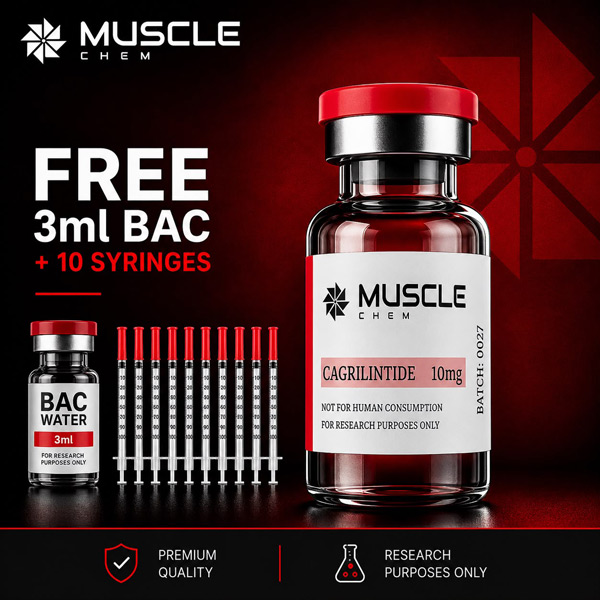
Cagrilintide – 10mg
Cagrilintide is a synthetic analogue of the hormone amylin, studied for its role in regulating appetite, satiety, and energy intake through activation of amylin receptor pathways in the brain and gastrointestinal system.
- Next-day UK delivery
- Appetite regulation
- Energy balance
- Gastric emptying
- Body weight research
- Metabolic control
Original price was: £99.99.£79.99Current price is: £79.99.
| Quantity | Discount |
|---|---|
| Buy 3 | 10% |
| Buy 4 | 12% |
| Buy 5+ | 15% |
- Description
- Reviews (12)
Description
Cagrilintide 10mg Vial – Next-Generation Amylin Analogue for Appetite Control & Weight Management
Cagrilintide is a synthetic analogue of amylin, a peptide hormone co-secreted with insulin from pancreatic β-cells. Amylin plays a physiological role in the regulation of postprandial glucose control, appetite signaling, gastric emptying, and satiety perception. Cagrilintide has been structurally modified to enhance metabolic stability and prolong receptor activity compared to native amylin.
Cagrilintide acts primarily through the amylin receptor complex, which includes calcitonin receptor (CTR) and receptor activity-modifying proteins (RAMPs). Activation of these pathways influences central appetite regulation in the hypothalamus and modulates gastrointestinal motility, contributing to reduced food intake in experimental models.
Cagrilintide is investigated as part of broader metabolic and obesity-related studies, particularly in relation to energy balance, feeding behavior, and combination approaches with incretin-based therapies. Its mechanism is distinct from GLP-1 receptor agonists, providing complementary insights into non-incretin appetite regulation pathways.
Product Contents
- Cagrilintide 10mg Lyophilised Powder
- Bacteriostatic Water
- 10 Sterile syringes
What Is It Used For and Its Purpose
Cagrilintide is primarily used in metabolic research focused on appetite regulation, energy intake control, and gastrointestinal hormone signaling. It serves as a tool compound for studying the amylin receptor system and its role in satiety signaling pathways within the central nervous system.
It is used to investigate how amylin receptor activation influences feeding behavior, gastric emptying rate, and postprandial metabolic responses. It is also studied in combination with other metabolic hormones to evaluate synergistic effects on energy balance regulation.
Research applications include:
- Metabolism (energy balance and substrate utilization)
- Endocrinology (pancreatic hormone signaling and satiety hormones)
- Neurobiology (hypothalamic appetite regulation pathways)
- Gastrointestinal physiology (gastric emptying and nutrient absorption)
- Obesity and body weight regulation models
Potential Scientific Benefits
Preclinical and early clinical research suggests that amylin analogues such as Cagrilintide may influence energy intake and metabolic regulation through central and peripheral satiety pathways. These effects are primarily mediated via amylin receptor activation in the brainstem and hypothalamus, which plays a key role in meal termination signaling.
In experimental settings, modulation of amylin signaling has been associated with reduced food intake, altered gastric motility, and changes in energy homeostasis. However, most findings are derived from controlled research models and early-phase studies, and should not be interpreted as established clinical outcomes. Observed and reported research activities include:
- Activation of amylin receptor-mediated satiety pathways
- Reduction in food intake in preclinical feeding models
- Delayed gastric emptying in experimental systems
- Modulation of hypothalamic appetite signaling circuits
- Potential influence on body weight regulation pathways in research models
Current evidence remains limited, and further well-controlled clinical studies are required to establish long-term efficacy and safety in humans.
Research Data Sheet
This section summarizes key physicochemical and identification data relevant for laboratory research use.
- Peptide: Cagrilintide
- Sequence: Modified long-acting amylin analogue (sequence proprietary/optimized)
- Classification: Synthetic Amylin Receptor Agonist
- Molecular Formula: Not consistently defined (analogue-dependent)
- Molecular Weight: ~4400–4600 g/mol (approximate)
- CAS Number: Not consistently assigned
- Form: Lyophilized powder
- Appearance: White to off-white solid
- Purity: ≥98%
- Solubility: Sterile water or bacteriostatic water under laboratory conditions
- Storage: 2–8°C short term; -20°C long term; protect from light
- Research Categories: Metabolic research, appetite regulation, endocrinology, obesity models, gastrointestinal physiology, neuroendocrine signaling
Safety Precautions
Cagrilintide is supplied strictly for laboratory research use only and is not intended for human consumption, diagnostic use, or therapeutic application. It should be handled only by trained personnel in controlled laboratory environments.
- Research use only
- Not for human consumption
- Not intended to diagnose, treat, cure, or prevent any disease
- Use appropriate PPE (gloves, lab coat, eye protection)
- Maintain aseptic laboratory handling procedures
- Store under recommended refrigerated or frozen conditions
- Avoid repeated freeze–thaw cycles
- Ensure proper labeling and containment
- Dispose of materials in accordance with institutional guidelines
- Limited long-term human safety data available
- Amylin receptor activity may influence multiple metabolic pathways
Conclusion
Cagrilintide is a synthetic amylin analogue used in research exploring appetite regulation, satiety signaling, and metabolic control. By targeting amylin receptor pathways, it provides a distinct mechanistic model separate from incretin-based systems such as GLP-1, making it valuable for comparative metabolic studies.
Its primary scientific relevance lies in its ability to modulate central appetite circuits and gastrointestinal function, contributing to research on energy balance and obesity-related physiology. Current evidence is derived mainly from preclinical and early-stage studies. Overall, Cagrilintide represents an important investigational tool for studying non-incretin mechanisms of appetite regulation and metabolic homeostasis.
Stacks Well With...
-
-
Peptides
IGF-1 LR3 | 1mg (Insulin-like Growth Factor-1)
Original price was: £69.99.£59.99Current price is: £59.99. -
Peptides
Glow Blend
Price range: £64.99 through £139.99This product has multiple variants. The options may be chosen on the product page -
Peptides
Tesamorelin
Price range: £49.99 through £119.99This product has multiple variants. The options may be chosen on the product page -
Peptides
Sermorelin
Price range: £44.99 through £109.99This product has multiple variants. The options may be chosen on the product page -
Peptides
Melanotan 1 – (MT1)
Price range: £34.99 through £79.99This product has multiple variants. The options may be chosen on the product page -





Adrian K. –
Cagrilintide helped control my appetite significantly. I feel fuller for longer and eat less overall.
Bennett R. –
Very effective for appetite management. Cravings are reduced, and consistency is easier.
Callum J. –
This product really supports portion control. Hunger feels much more manageable.
Dominic P. –
Appetite suppression is smooth and steady. No sudden crashes or discomfort.
Elias M. –
Cagrilintide works well for reducing constant hunger. Makes dieting far easier.
Finley T. –
Noticed a clear reduction in food cravings within the first week.
Garrett L. –
Helps me stay on track with calories. Feeling satisfied with smaller meals.
Harrison C. –
Very effective appetite control. I’m eating more intentionally now.
Julian W. –
This made a big difference in controlling hunger throughout the day.
Nolan D. –
Appetite is much more stable. Helps avoid unnecessary snacking.
Owen B. –
Works exactly as expected. Hunger signals are reduced without feeling drained.
Spencer H. –
Great support for appetite regulation. Makes sticking to a routine much easier.